The January 2026 edition of FRAMES Digital opens the year with a collection that feels both grounded and urgent. Across documentary work, philosophical writing, long-form conversation, book reflection, and community voices, this issue asks a shared question from many angles: what remains when time moves on, and how do photographs help us notice it?
On the road, looking for connection
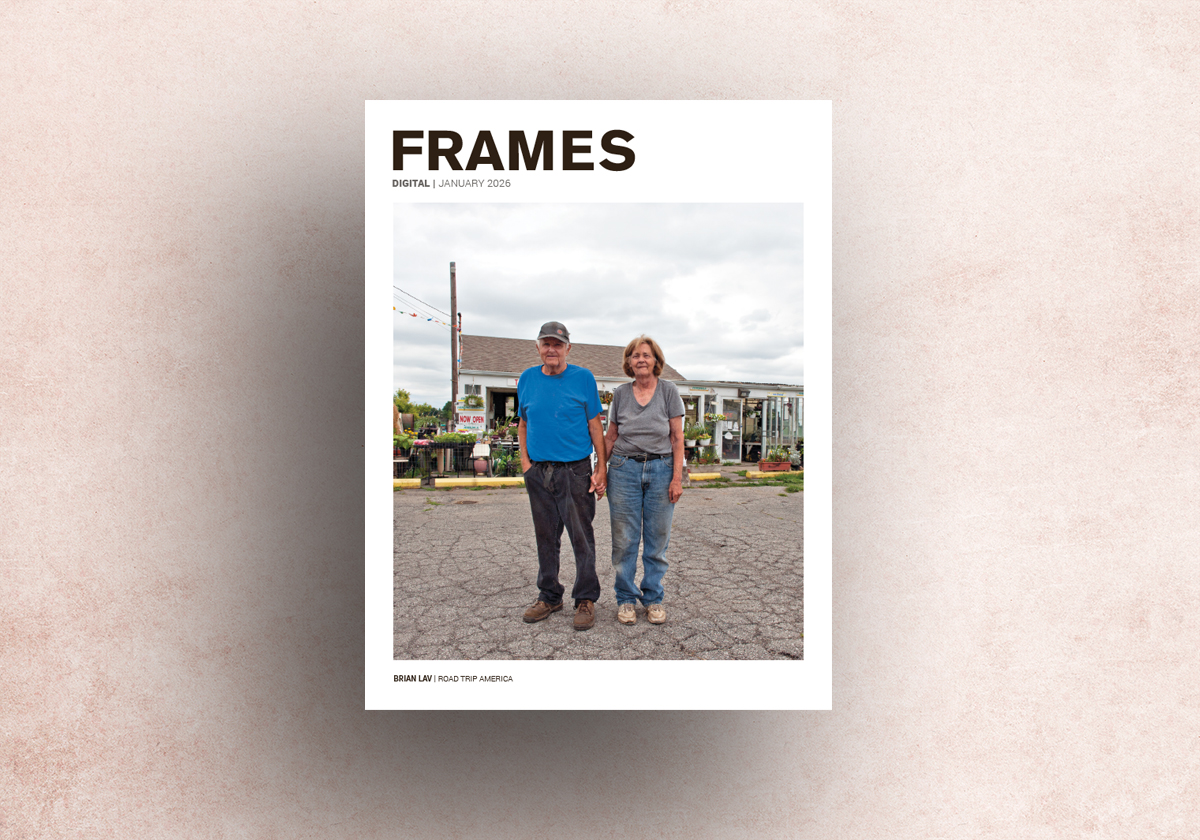
The issue begins with Brian Lav’s Road Trip America, a deeply human photographic journey across the United States. Lav’s work is not about spectacle or nostalgia, but about encounters—people met by the roadside, quiet towns, modest buildings, and landscapes that resist simplification. His photographs are shaped by conversation, patience, and curiosity, reminding us that photography can still be an act of listening. The series becomes less about travel and more about presence: a slow, attentive way of seeing an America often overlooked.
Photography as thought, not representation
From lived experience, the issue moves into theory with Attila Szántó’s essay Photography as Non-Representation — The Ontology of the Image. Szántó challenges the idea of the photograph as mere record or memory. Instead, he proposes photography as an event—something that happens between light, place, photographer, and viewer. Drawing on in-camera multi-exposure and phenomenological thinking, the essay invites us to consider photographs not as objects we consume, but as spaces we enter.
Confronting America’s haunted past
In one of the most powerful features of the issue, Gina Williams writes about Rich Frishman’s long-term project Ghosts of Segregation in Stitching a Quilt of Compassion from America’s Haunted Past. Frishman photographs ordinary buildings, entrances, walls, and landscapes—places that carry the invisible residue of racial segregation. Through meticulous stitched imagery and careful research, his work refuses easy answers, instead asking viewers to look longer and reckon with what still lingers in the built environment. It is photography as witness, memory, and ethical challenge.
Community, dignity, and everyday life
With 2016 Florida Mobile Home Park, Robert Levy turns his camera toward communities often reduced to stereotype. Over the course of a road journey through Florida, Levy documents mobile home parks with care, curiosity, and respect. His photographs reveal complexity rather than caricature—moments of resilience, individuality, and shared daily rhythms. The project is as much about trust and self-reflection as it is about place.
A conversation shaped by history and quiet observation
In a wide-ranging and intimate conversation, Alasdair Foster speaks with Polish photographer Wojciech Karliński in Poems Without Words. Karliński reflects on growing up under communism, photographing ordinary spaces, and returning attention to places so familiar they become invisible. From train stations to small-town housing estates and backstage moments in a children’s theatre, his work finds poetry in restraint and meaning in what most of us pass by without noticing.
Reading photographs, one image at a time
The issue’s reflective rhythm continues with W. Scott Olsen’s Untitled by Lowell Wolff, a close reading of a single abstract image. Olsen invites readers to slow down and stay with the photograph—examining structure, movement, emotion, and invention. It’s a reminder that innovation in photography is not only technical, but conceptual: sometimes it begins by turning background into subject.
Learning through books
In Learning From Photography Books, Howard Grill makes a thoughtful case for the photobook as one of the most powerful tools for photographic growth. Beyond inspiration, books teach sequencing, intention, and ways of seeing that single images online cannot. Grill encourages curiosity—especially toward work outside one’s usual genre—as a way to refresh vision and deepen understanding.
Books, briefly noted
Returning to the printed page, W. Scott Olsen also curates Books Briefly Noted, offering concise reflections on a wide range of recent photobooks. This section functions as both a reading guide and an invitation, pointing toward voices and projects worth spending time with.
Community spotlight
The issue closes by turning outward to the FRAMES community itself. In the Community Spotlight, work by Russell Boyce and Caesar Lima reminds us that FRAMES is not only a publication, but a shared space—one shaped by photographers around the world, each contributing their own way of seeing.
Together, the January 2026 edition of FRAMES Digital forms a quiet but powerful whole. It moves between road and room, theory and practice, history and the present moment—always returning to photography’s ability to slow us down, ask better questions, and help us notice what endures.
FRAMES members: You can download the new edition right now.
Not a member yet? Join FRAMES today and become part of a global conversation about photography that values depth over distraction, reflection over speed, and images that endure far beyond the instant of their making.
Each year, we publish twelve issues of FRAMES Digital – PDF publications complementing the main printed editions of the FRAMES Magazine. They feature additional imagery and written content in a high-resolution digital publication delivered directly through the FRAMES Subscriber Area.