I am a landscape photographer specializing in panoramic photography based in Glenbrook, Australia.
As a member of the Blue Mountains photography group, we are encouraged to make photographs and to print them. We have an appointed judge who comes and critiques our work and gives it a score out of 15. We are allowed to showcase 4 prints this is one of them.
I originally photographed this scene in color, and I made a choice later to make it in monochrome to give it a minimalistic feel.
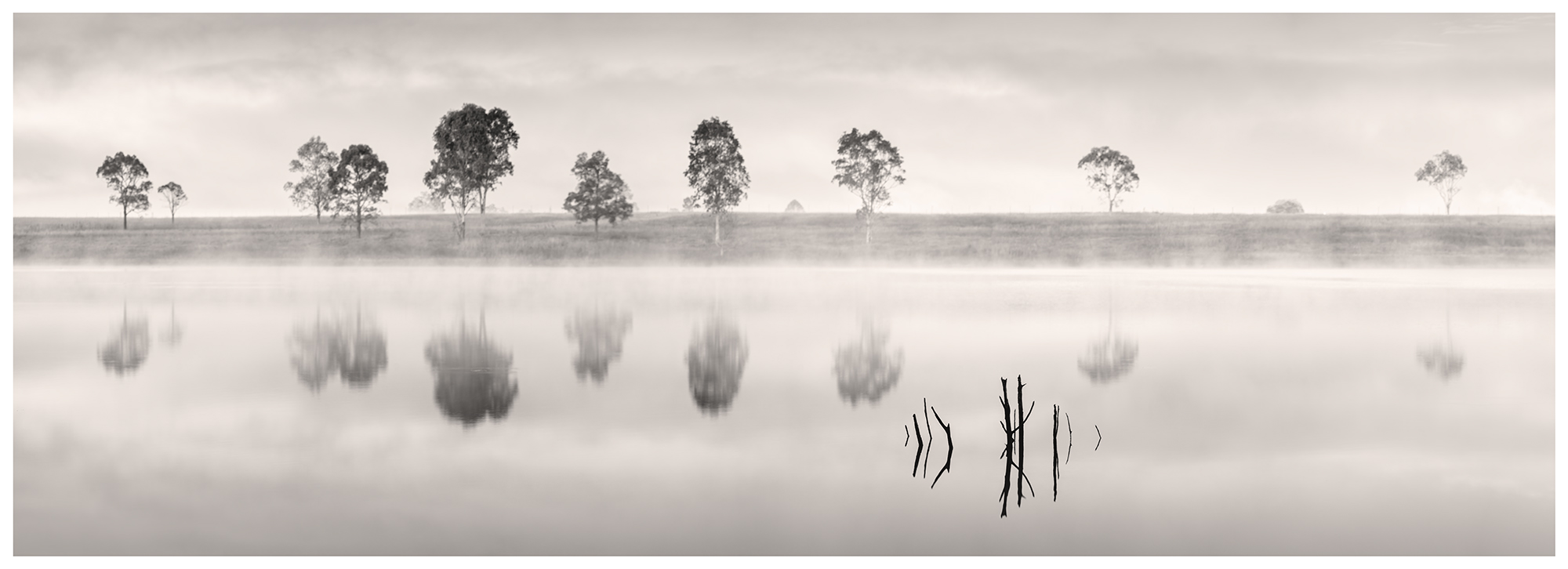
This panoramic black-and-white photograph captures a serene, ethereal landscape dominated by a still body of water, a line of distant trees, and a pervasive morning mist. The composition is strikingly horizontal, emphasizing the vastness and quietude of the natural world.
Composition and Structure
The image is built upon a foundation of symmetry and balance. It is divided into three distinct horizontal bands:
The Upper Band: A soft, overcast sky filled with diffused light and low-hanging clouds or fog.
The Middle Band: A grassy shoreline populated by a series of sparsely spaced, deciduous-style trees.
The Lower Band: A glass-like water surface that acts as a perfect mirror, reflecting the world above.
The focal point is the line of trees, which serves as a rhythmic anchor across the center of the frame. These trees are not uniform; they vary in height, canopy density, and distance from one another, creating a natural cadence that prevents the image from feeling overly clinical or manufactured.
The Interplay of Light and Mist
The lighting is extraordinarily soft, suggesting either dawn or a heavily overcast morning. There are no harsh shadows, which contributes to the image’s “dreamlike” quality.
Atmospheric Perspective: A thick layer of mist clings to the surface of the water and the base of the trees. This creates a sense of depth, as the trees appear to emerge from a white void, blurring the boundary between the land and the water.
The Reflection: The water is so still that the reflections are nearly as sharp as the subjects themselves. This doubling of the imagery creates a sense of “Rorschach” symmetry, where the dark shapes of the trees are pulled downward into the pale grey of the water.
Key Visual Elements
The Trees
The trees are the only dark, high-contrast elements in an otherwise high-key (light) photograph. They appear as silhouettes against the pale background. Their skeletal structures are visible through their foliage, suggesting a season of transition—perhaps late autumn or early spring.
The Submerged Branches
In the lower-right quadrant, a cluster of dead, leafless branches breaks the water’s surface. Unlike the distant trees, these are in the foreground and provide a stark, graphic detail. Their jagged, vertical lines contrast with the soft, rounded forms of the living trees in the distance. The reflection of these branches is exceptionally clear, forming a symmetrical, spindly shape that adds a touch of melancholy to the scene.
The Horizon Line
The horizon is intentionally softened by the mist. While there is a clear line where the grass meets the fog, the “true” horizon where the earth meets the sky is obscured. This lack of a definitive boundary gives the photograph an infinite, boundless feeling.
Mood and Atmosphere
The photograph evokes a profound sense of stillness, isolation, and contemplation. The choice of a monochromatic palette (shades of silver, grey, and charcoal) strips away the distractions of color, forcing the viewer to focus on form, texture, and light.
There is a “liminal” quality to the image—it captures a moment in time that feels fleeting, as if the rising sun might evaporate the mist and shatter the glassy surface of the water at any second. It is a study in silence; looking at the image, one can almost imagine the lack of sound, save perhaps for the distant call of a bird or the soft lap of water.
Technical Execution
The panoramic crop is essential to the impact of the piece. By extending the horizontal field of view, the photographer forces the eye to travel slowly across the scene, mimicking the way one would scan a real horizon. The high-key exposure ensures that the whites are luminous without losing detail in the subtle textures of the clouds and the mist.
In summary, this is my take on minimalist landscape photography. It uses a simple arrangement of natural elements to create a complex emotional experience, inviting the viewer to pause and find beauty in the quiet, hushed corners of the world.
What are the TWO most impactful features that make your image a good photograph? Don’t be shy!
Composition and minimalism.
If you could make this photo again, what would be the ONE thing you would like to do better or differently?
By fine-tuning the timing to that specific window where the mist is most “active” and the light is at its most directional
Stephen Georgiou shared this photograph with the FRAMES Facebook Group.
Photographer
Stephen Georgiou, Glenbrook, Australia
Print inquiries: georgioufineartphotography@gmail.com
Equipment and settings
Nikon D810 + 18-35mm lens
Manfrotto tripod
Printed on Hahnemühle Photo Rag fine art paper

FRAMES is a unique international photography community that combines the best of all worlds, bringing you print and digital publications, a global membership platform, access to live events, and a dedicated mobile application.
EXPAND YOUR PHOTOGRAPHIC VISION
JOIN FRAMES TODAY