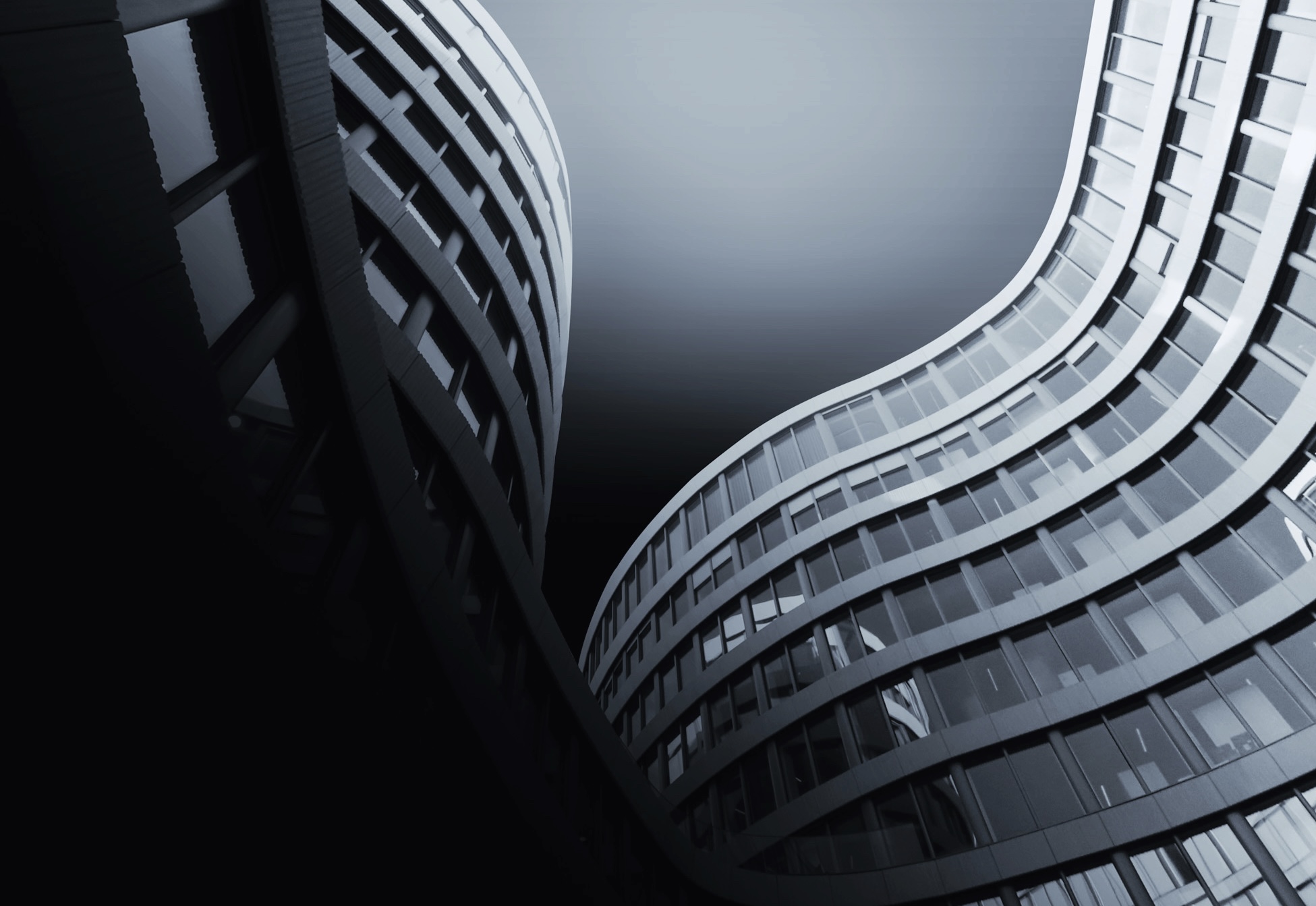
One of my favorite black-and-white architectural photographs—shot from a low angle—transforms a complex of buildings into a striking, graphic sculpture. Two facades with undulating curves rise on either side of a sky that shifts in tone, ranging from a luminous, bluish-gray at the center to a deep, rich black in the corners. This S-shaped opening in the sky almost feels like an integral part of the architecture itself, morphing into the form of a wave.
What draws me in first is the rhythm of the horizontal bands. Each floor is defined by a wide, sweeping strip that follows the curve of the facade, creating fluid lines that seem to spiral upward. On the right, these lines trace an elegant wave, while on the left—shrouded in shadow—the same structure remains, hinted at in a more mysterious way.
The use of light is equally compelling. The glass surfaces on the right-hand facade catch reflections and subtle shades of gray, revealing glimpses of offices and interior volumes through their transparency. Conversely, the left side is almost entirely swallowed by darkness, which heightens the contrast and lends a profound sense of depth to the image.
The shooting angle accentuates the verticality, creating a dizzying perspective—as if the buildings were leaning toward the viewer. The high-contrast, monochrome treatment strips away any distractions, leaving only the essential forms, textures, and lines.
The result is an image that is simultaneously restrained, dramatic, and distinctly modern—a tribute to contemporary architecture and its unique capacity to play with both light and curvature.
What are the TWO most impactful features that make your image a good photograph? Don’t be shy!
Light and blue grey color.
If you could make this photo again, what would be the ONE thing you would like to do better or differently?
Less black in the left side.
Lucie Côté shared this photograph with the FRAMES Facebook Group.
Photographer
Lucie Côté, Montréal, Canada
Equipment and settings
Nikon Z5II

FRAMES is a unique international photography community that combines the best of all worlds, bringing you print and digital publications, a global membership platform, access to live events, and a dedicated mobile application.
EXPAND YOUR PHOTOGRAPHIC VISION
JOIN FRAMES TODAY