
There are photographs that announce themselves immediately, and there are others that spend decades quietly waiting for their meaning to emerge.
This photograph belongs firmly in the second category.
I made it during the winter of 1978 while living in Bloomington, Indiana. I was in my twenties, carrying a 35mm film camera almost everywhere, photographing without any clear sense of what would eventually become “my work.” Like many photographers of that age, I was driven more by curiosity than by intention. I wasn’t thinking about projects, exhibitions, or books. I simply wandered, looking for those brief moments when ordinary places became visually extraordinary.
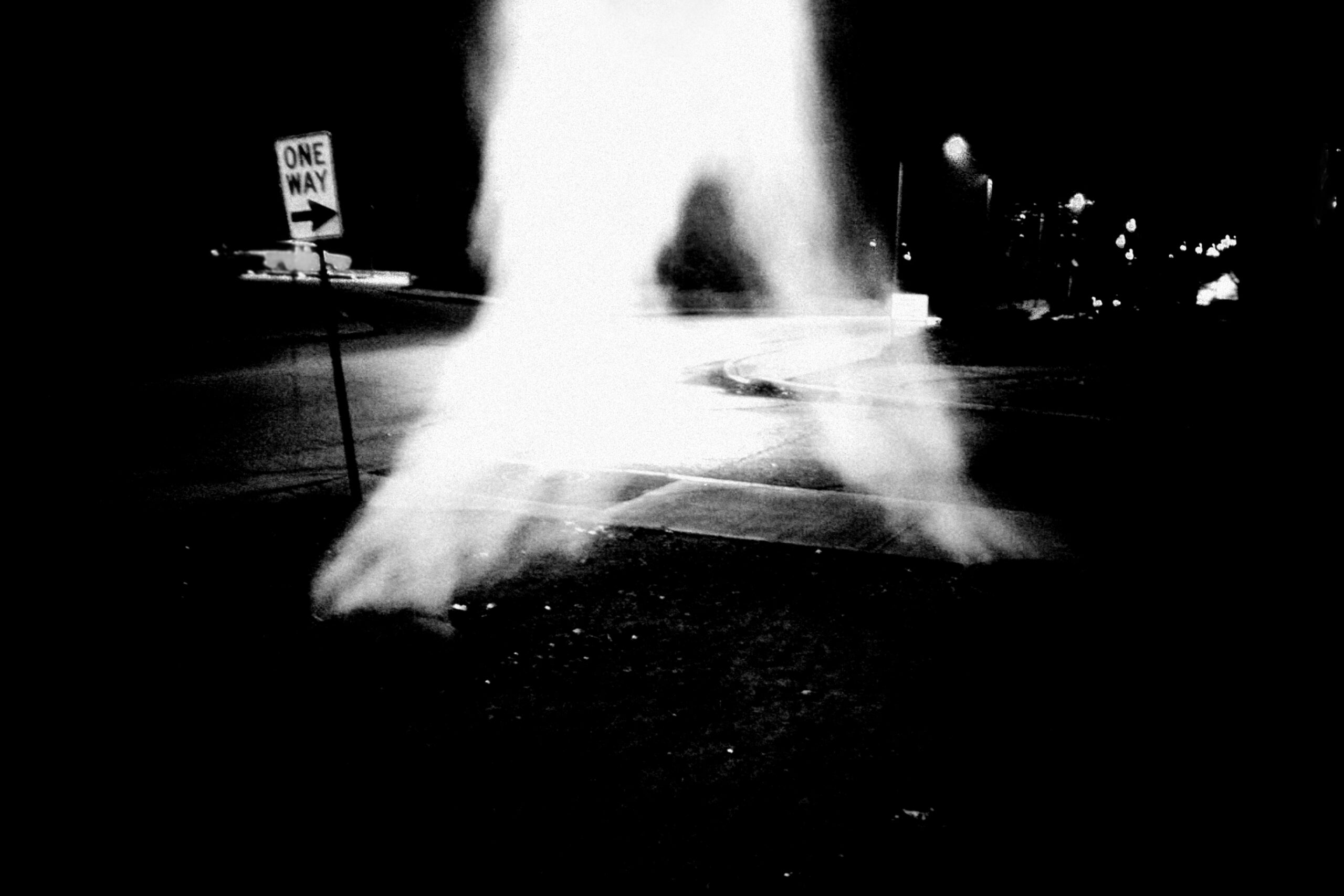
One evening I came across steam pouring from a district heating vent into an otherwise empty street. It was an unremarkable piece of urban infrastructure, something that local residents probably passed every day without noticing. But under the streetlights, the escaping steam transformed the intersection into something entirely different. The cloud became almost architectural, filling the space like a temporary building. Every person who entered it was instantly dissolved, only fragments remaining visible before disappearing again.
As I watched, a pedestrian crossed through the plume. For a fraction of a second, the figure seemed neither solid nor transparent, neither present nor absent. The body was consumed by light while the darker silhouette lingered deeper within the steam. The scene felt less like documentary photography than theatre. I made one exposure almost instinctively.
I walked away thinking I had photographed an unusual visual event. Nothing more.
The negative was filed away with hundreds of others and, like many photographs made before the digital era, it largely disappeared into boxes and folders as life moved on.
Over the following decades, my photography continued, although without any conscious attempt to revisit this particular image. Cameras changed. Countries changed. My interests broadened. Yet one thing remained remarkably consistent: I found myself repeatedly drawn to people in transition rather than at rest. I became fascinated by reflections, movement, long exposures, windows, glass, architectural spaces, and those fleeting moments where the certainty of seeing begins to dissolve.
At the time, I never connected these photographs to the Bloomington image. It was only many years later, while revisiting old negatives to create a retrospective of work spanning almost fifty years, that I rediscovered this frame.
The experience was unexpectedly emotional—not because of nostalgia, but because of recognition.
Looking at the photograph with the benefit of time, I realized I wasn’t simply looking at an old picture. I was looking at the earliest expression of an idea that had quietly accompanied me throughout my photographic life.
The image already contained the visual vocabulary that would later emerge much more deliberately in my work: figures whose identities are obscured, movement replacing certainty, architecture becoming a stage, and atmosphere transforming reality into something psychologically charged. It wasn’t simply about steam. It was about perception itself.
That realization eventually led to my 2026 photobooks Persistence of Vision and Spectral Shift. Although the books contain contemporary photographs made decades after this one, their central concerns are remarkably similar. Throughout the books, series, people drift through railway stations, museums, galleries and city streets, appearing briefly before dissolving into reflections, shadows or motion blur. The photographs ask viewers to slow down and question what they think they have seen. Rather than celebrating the decisive moment, they explore the uncertain moment—the one that exists somewhere between observation and memory.
Seen in that context, this photograph no longer feels like an isolated success from my early years. Instead, it has become the beginning of a conversation that continued for almost half a century.
Photography often encourages us to think in terms of single images or individual projects. But perhaps our most enduring work develops differently. Perhaps certain questions stay with us throughout our lives, even before we are fully aware of them. We photograph them repeatedly, in different cities, with different cameras and under different circumstances, gradually refining a visual language whose origins remain hidden until we finally look backward.
This image taught me that lesson.
The young photographer standing on that street corner in Bloomington could never have imagined that, nearly fifty years later, he would still be making photographs shaped by exactly the same fascination with transience, ambiguity and the fragile nature of perception.
Sometimes we discover what our work is really about only after we have spent a lifetime making it.
That, for me, is the real story behind this photograph. It is not simply a picture of steam illuminated by streetlights. It is the first chapter of a story I didn’t yet know I was writing.
What are the TWO most impactful features that make your image a good photograph? Don’t be shy!
Transforming the ordinary into the uncanny.
A commonplace street scene becomes psychologically charged through the interaction of steam, light and a passing figure. The photograph invites multiple interpretations rather than offering a straightforward documentary record.
A moment that could never be repeated.
The image relies on the precise alignment of atmosphere, illumination and human movement. That fleeting convergence creates a picture that feels suspended between reality and apparition.
It foreshadows a visual language that continued for nearly fifty years. Looking back, this image contains many of the themes that later became central to my photography—transience, obscured identity, movement, and the uncertainty of perception.
If you could make this photo again, what would be the ONE thing you would like to do better or differently?
If I could revisit the scene today, I wouldn’t change the photograph itself—I would change the amount of time I spent with it. In 1978 I recognized an unusual moment and reacted instinctively. Today I would stay longer, allowing the scene to unfold and exploring the many ways light, steam and passing figures could interact. Experience has taught me that patience often reveals possibilities beyond the first successful frame.
Robert Matthews shared this photograph with the FRAMES Facebook Group.
Photographer
Robert Matthews, Perth, Western Australia
Equipment and settings
Canon AE-1 fitted with a Canon FD 50mm f/1.8 lens.
Photographed on 35mm black-and-white negative film.
Unfortunately, the original film stock and exposure settings have been lost over the intervening decades, although the image was most likely made using the AE-1’s aperture-priority automatic exposure mode.

FRAMES is a unique international photography community that combines the best of all worlds, bringing you print and digital publications, a global membership platform, access to live events, and a dedicated mobile application.
EXPAND YOUR PHOTOGRAPHIC VISION
JOIN FRAMES TODAY
Bradford Armstrong
August 31, 2026 at 19:22
Wonderful story. Such deep understanding of your life as an evolving photographer. Seeing is key sometimes meaning comes later but subconsciously we instinctively stop and our mind say’s shoot it! I see something that’s relevant to me. I have to photograph this!