
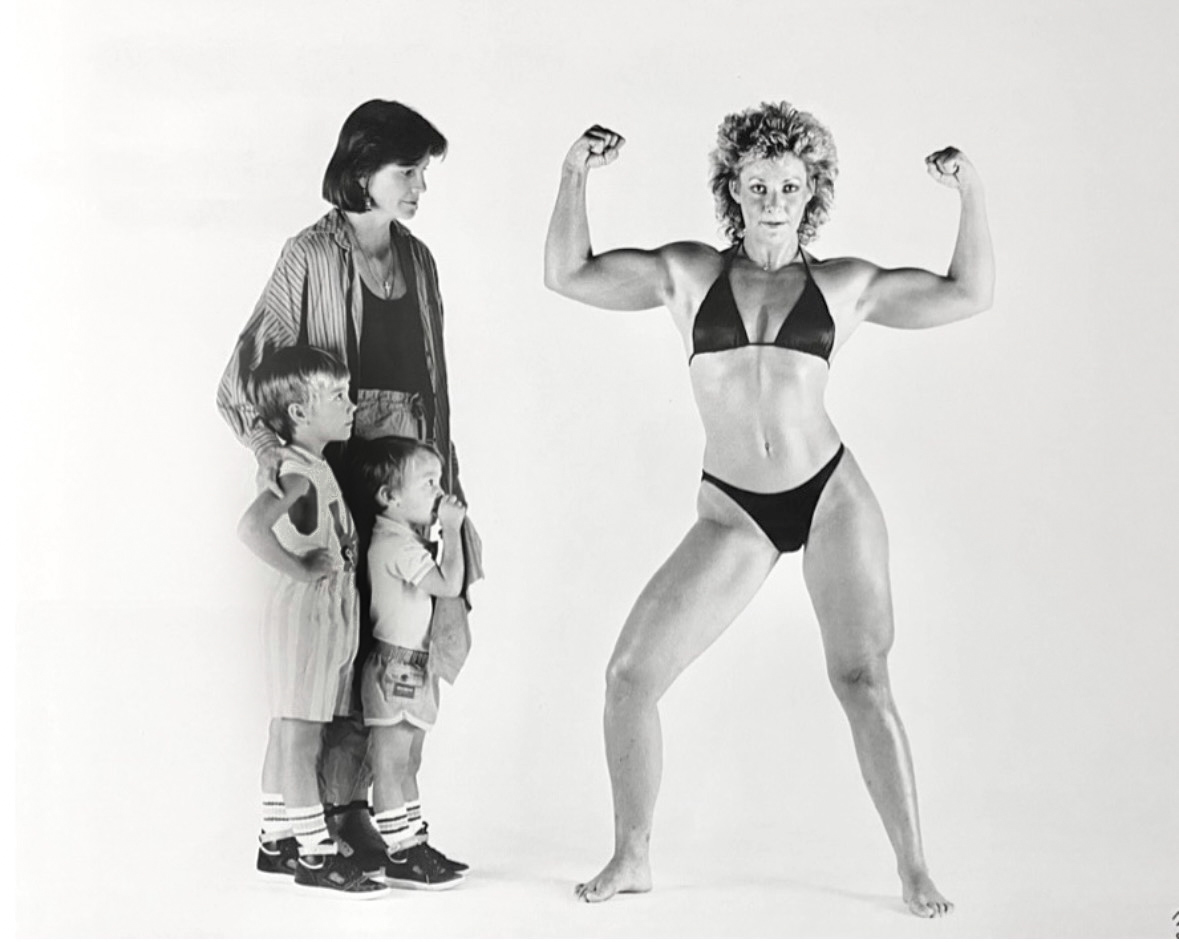
In the beginning, when I wanted to be a photographer, I frequently went to my local pizza place.
I met a guy there, a local hustler named Bill, who wanted to start a wrestling group. He asked me to photograph his wrestlers for promotional photos. No money, but he did pay for the film and processing. I thought, why not? I would get some interesting characters in front of my camera.
What we both had in common was that we were trying to start our careers from nothing. Very little money, but a passion for hard work, ambition, and a never-quit ethic. We kept at it for about a year and a half, until everyone quit because no one was getting paid.
Bill was pocketing all the money from the wrestling events.
That’s when I met Brenda.
She was a bodybuilder, not a wrestler, but she also asked me to take some pictures of her. I said, “Absolutely!” because people like this don’t just walk into your life. So yes, I was hungry to learn!
I did what I could and set up a white seamless in the backyard. When we were done, I asked my wife and our two young children to come out of the house and marvel at this woman. I wanted them to see Brenda and to see what I was doing. What struck me was how much bigger she was than my average-sized wife, with my kids looking up at her in wonder.
I later went on to work for other people in weddings, doing stills and video. I got tired of that fairly quickly, then moved on to an event company.
The owner provided Hasselblads with Norman 200B flash heads for convention shooting. I was getting $10 an hour when I found out he was billing me out at $75 an hour. I asked for $20 an hour and was fired that same day.
Then I started shooting advertising for a local newspaper. I did that for about two years and was finally hired by the editorial staff as a staff photographer. That career lasted twenty years. I received more than 30 photojournalism awards, the National Humanitarian Award from the National Press Photographers Association, had one of my portraits accepted into the Smithsonian National Portrait Gallery in Washington, D.C., and had magazine covers featured in an HBO documentary on the now-deceased Sen. Barry Goldwater.
My photojournalism career ended in 2009, when I was Photo Editor—the same year the paper won the Pulitzer Prize for reporting by two of our reporters. Then I went on to work in commercial photography for another 11 years.
So the moral of the story is: never give up on your dream, no matter what it is. Sacrifice, work hard, and eventually you’ll get there.
What are the TWO most impactful features that make your image a good photograph? Don’t be shy!
I was going for a reaction, which did happen, but in a very quiet way. I hate to use the word juxtaposition, but that’s really what I was going for. I just didn’t get the reaction I had hoped for. I think my kids were too young to respond the way older children might have.
If you could make this photo again, what would be the ONE thing you would like to do better or differently?
I really don’t think I would change anything. At that time in my evolution as a photographer, this is where my creative imagination was going. I was learning and experimenting. I was trying to go beyond the obvious and be different by expressing the uniqueness of my life at that moment.
I shot this in my backyard. I had almost nothing in terms of money or equipment. Everything I had was the result of trading something or bartering for a service.
I believe our curiosity, vision, skills, and interests evolve throughout our lives. When I made this picture, I don’t think I would have changed anything because that was the full extent of my experience and curiosity at the time. As a result, it helped me become better, and it helped move my photography—and eventually my career—forward.
Brad Armstrong shared this photograph with the FRAMES Facebook Group.
Photographer
Brad Armstrong, Phoenix, Arizona USA
Equipment and settings
Nikormat 35mm camera + two Norman 200B battery pack strobes with umbrellas.

FRAMES is a unique international photography community that combines the best of all worlds, bringing you print and digital publications, a global membership platform, access to live events, and a dedicated mobile application.
EXPAND YOUR PHOTOGRAPHIC VISION
JOIN FRAMES TODAY
Brad Armstrong
August 30, 2026 at 18:33
I am supremely honored to be recognized by the editors and founders of Frames. I’ve never had the international reach with my work, life and growth as a photographer. Thank you for sharing my story with this incredible group!