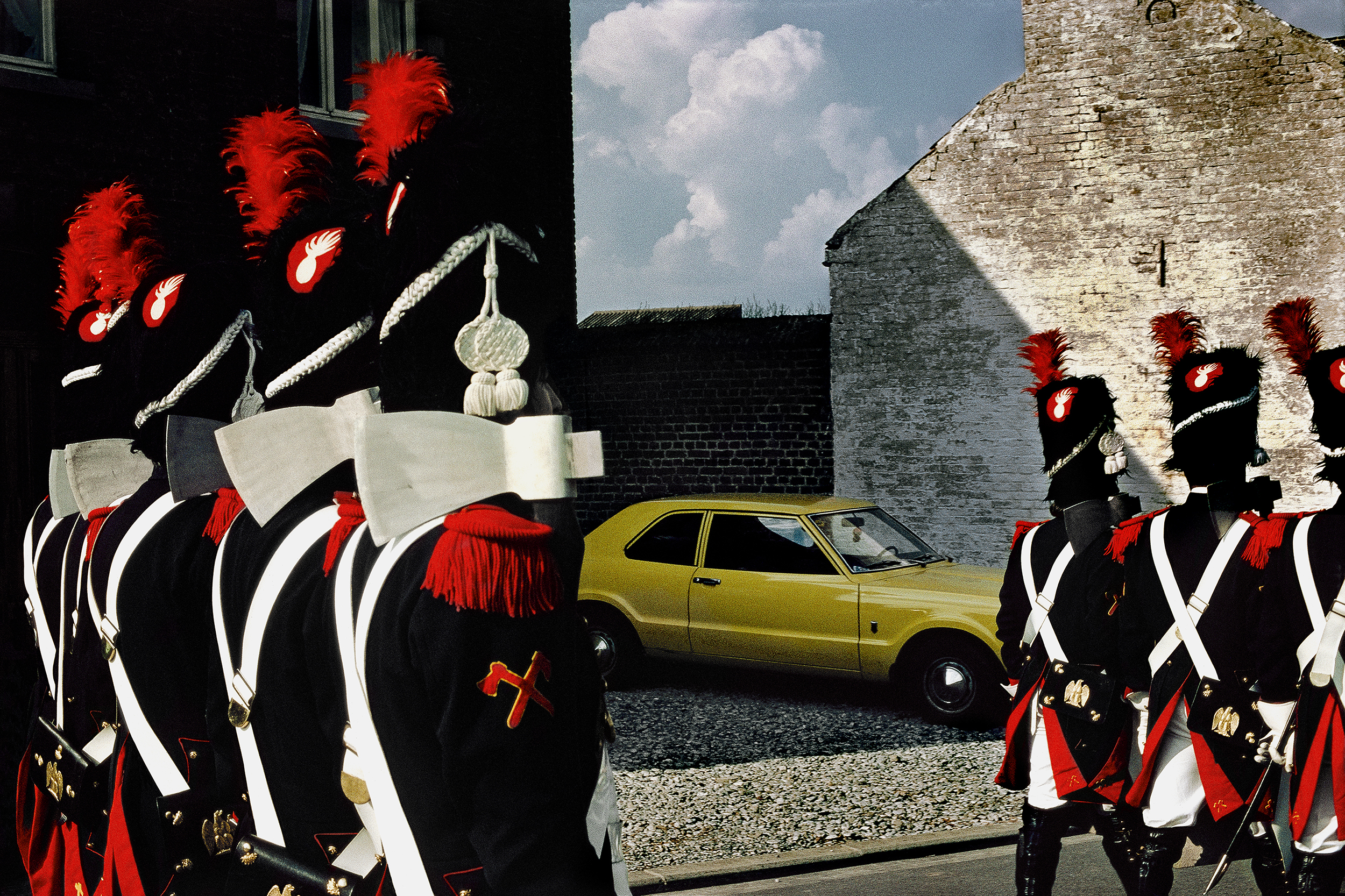
The exhibition dedicated to Harry Gruyaert at the 57th edition of Les Rencontres d’Arles 2026—running from 6 July to 4 October 2026—stands as a fitting tribute to one of contemporary photography’s most accomplished practitioners of color. A member of the Magnum Photos agency since 1982, Gruyaert has consistently demonstrated an extraordinary ability to employ color with both intensity and refinement, transforming it from a descriptive element into a fundamental narrative device.
Above all, Gruyaert is an intuitive traveler. Whether working on assignment or traveling for personal reasons, he possesses an exceptional sensitivity for the subtle details that define a place. His photographs distill the essence of a location through a consistently perceptive yet never predictable gaze. Even today, the persona conveyed by his images appears considerably more extroverted than the man himself. In person, Gruyaert is distinguished, discreet and at times shy—a careful observer whose curiosity becomes particularly evident during public events, such as the opening of his exhibitions. There, the enthusiasm and sheer number of admirers often seem to catch him by surprise. During interviews, he responds thoughtfully, carefully considering each answer before speaking, with the same precision and clarity that characterize his photographic language.
Henri Cartier-Bresson famously described photography as the alignment of “head, eye and heart.” That principle, inherited from one of Gruyaert’s closest friends and mentors, finds perhaps one of its most accomplished expressions throughout Gruyaert’s career. His instinct for the decisive moment is unmistakable, while his sophisticated orchestration of color—frequently punctuated by carefully controlled areas of shadow—imbues even the most ordinary scenes with remarkable visual depth.
A striking example is his photograph taken in southern Morocco in 1976. In a single, perfectly timed frame, Gruyaert captured the fleeting gesture of a Moroccan woman raising her arm to shield her face. That movement unexpectedly reveals the back of the child she carries, wrapped in a vivid red-and-white scarf, while a goat positioned at the edge of the composition immediately anchors the scene both geographically and socially. It is an image that exemplifies his remarkable capacity to combine formal precision with narrative resonance.
For Gruyaert, color is never merely decorative. It functions simultaneously as a source of visual surprise and as a profound reflection of his personal and cultural background. Raised in a deeply Catholic family, as he himself has often recalled, he left Belgium at an early age, feeling constrained by an environment that offered little space for his artistic ambitions. Photography soon became both his vocation and his passport to the world, leading him to live and work in places including Morocco, Paris, and New York.
Yet despite this early departure from home, the influence of his family remained significant. His father was an enthusiastic amateur filmmaker who continually documented family life with an 8mm camera. It was through these early moving images that Gruyaert first developed the ambition to become a filmmaker. His cinematic references naturally gravitated toward masters such as François Truffaut, Ingmar Bergman and Michelangelo Antonioni, while Antonioni’s Blow-Up proved especially formative—almost prophetic in anticipating the visual sensibility that would later define his photographic practice.
Cinema, however, demanded financial resources beyond his reach, making photography both a practical and deeply natural alternative. His embrace of color photography emerged at a historical moment when serious, intellectually ambitious photography was still overwhelmingly associated with black-and-white. Gruyaert challenged that convention by demonstrating that color could possess equal conceptual sophistication and emotional complexity. What had often been regarded as merely descriptive became, in his hands, a fully expressive visual language and the defining signature of his oeuvre.
His mastery of color earned the admiration of Henri Cartier-Bresson himself, who encouraged Gruyaert to introduce color into some of his own work and offered thoughtful suggestions that further refined Gruyaert’s visual approach. Such recognition from one of photography’s greatest figures represented both an extraordinary endorsement and a well-deserved acknowledgment of Gruyaert’s originality.
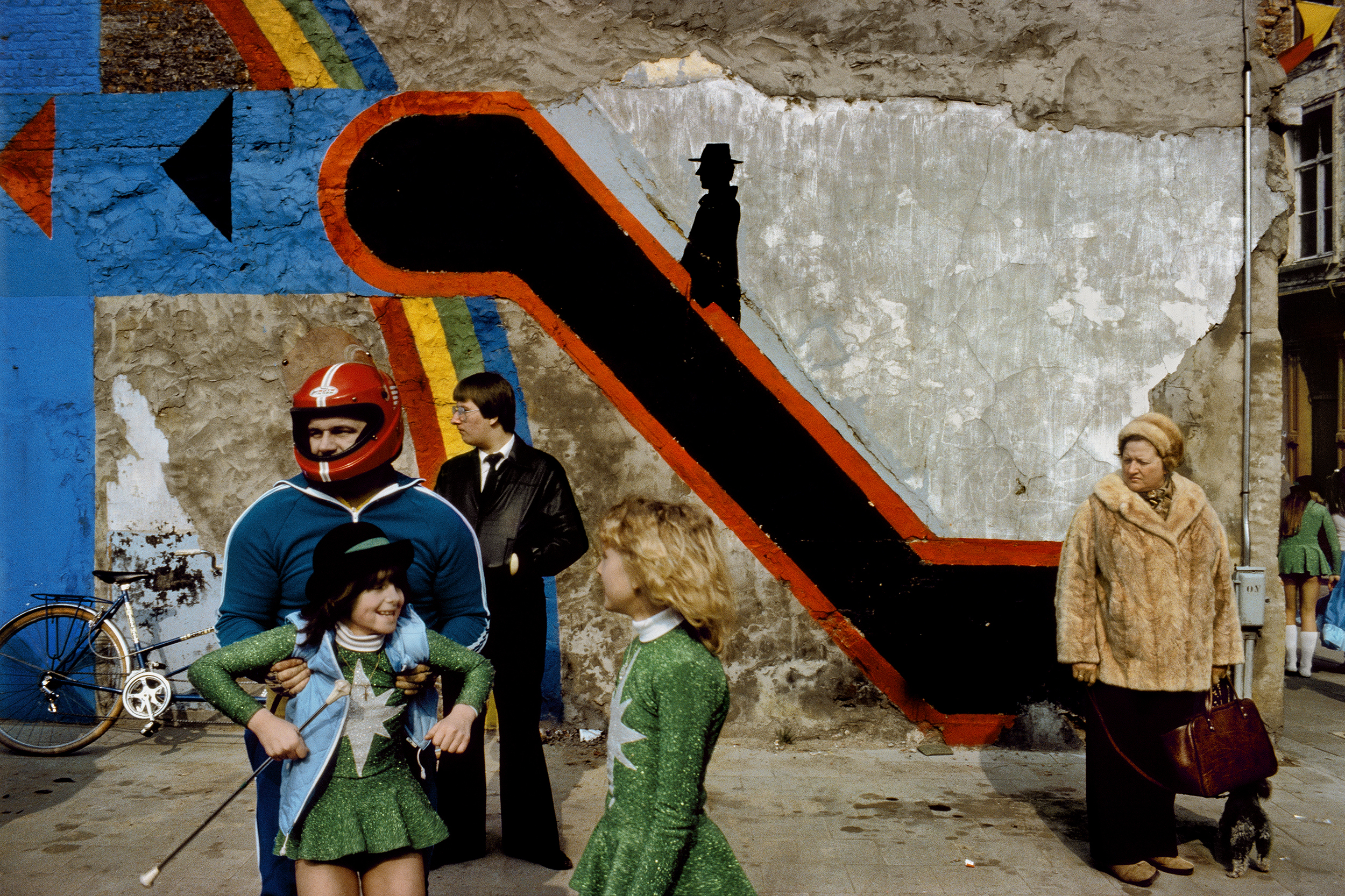
The same admiration has been expressed by Raymond Depardon, another photographer renowned for his nuanced use of color. Depardon has remarked upon Gruyaert’s remarkable ability to reinterpret urban environments—Paris in particular—through a vibrant palette that reveals overlooked yet unmistakably characteristic aspects of everyday life, anticipating visual sensibilities that would later become commonplace.
Perhaps Gruyaert’s greatest achievement lies in his approach to photographing people. His images are deeply human yet never intrusive. Rather than confronting his subjects directly, he often works from carefully chosen peripheral positions that allow him to observe quietly before releasing the shutter. This understated methodology is evident throughout his work: the photographs convey extraordinary immediacy while preserving the complete unselfconsciousness of their subjects, who often remain entirely unaware that they have become part of the image.
As Cartier-Bresson observed, “Photography can fix eternity in a moment.” Harry Gruyaert’s body of work stands as one of the most eloquent demonstrations of that enduring proposition.
HARRY GRUYAERT
A SENSE OF PLACE (Le sens du lieu)
Curator: Géraldine Lay
Dates: 6 July – 4 October 2026
Opening hours: 9:30 a.m. – 7:30 p.m.
Chapelle Saint-Martin du Méjan – Arles
ABOUT THE AUTHOR
Silvia Ionna is an independent Art Director. She writes about photography, art, and books for various online magazines.

FRAMES is a unique international photography community that combines the best of all worlds, bringing you print and digital publications, a global membership platform, access to live events, and a dedicated mobile application.
EXPAND YOUR PHOTOGRAPHIC VISION
JOIN FRAMES TODAY