Perhaps From Our Windows, the exhibition bringing together Rinko Kawauchi and Tokuko Ushioda at Vague Arles as part of Les Rencontres d’Arles 2026, might begin in a kitchen.
Not necessarily the kitchen of Kitchen, Banana Yoshimoto’s novel in which the domestic space becomes a place of mourning and renewal, but any kitchen: a place where things are consumed, stored, washed and put away; where time is measured through repeated gestures and private life leaves its most tangible traces. A full refrigerator, a table, a forgotten object, a window through which the light enters. It is here, in the seemingly most ordinary spaces of existence, that the photographic practices of Tokuko Ushioda and Rinko Kawauchi find one of their possible points of departure.
In Kitchen, the home is far more than a domestic setting: it is a space of transformation, a refuge where loneliness and grief can gradually become the ground for new forms of connection. The kitchen is the heart of an everyday life that does not need to be celebrated in order to be essential. It is a perspective that offers a way into the work of two Japanese women photographers, separated by generations yet united by their decision to turn their gaze towards what is close at hand, within the private and familial sphere.
This choice takes on a particular significance when considered against the history of Japanese society. Within the traditional family structure, women for centuries occupied a central role in managing the household, raising children and transmitting domestic memory, often within a system that constrained their autonomy in the public sphere. The home was therefore both the site of female responsibility and the boundary of women’s social visibility.
It is significant that two women photographers should choose precisely this territory — the home, the family, objects, bodies and habits — to construct a personal narrative that, through intimacy, becomes universal. Their photography does not seek a distant world; instead, it begins with what is within reach. And precisely for this reason, it is able to engage with questions of time, memory and the fragility of existence.
Courtesy of the artist and PGI.
Tokuko Ushioda, born in Tokyo in 1940, belongs to a generation for whom pursuing an artistic career as a woman could not be taken for granted. Trained at Kuwasawa Design School and a student of Kiyoji Otsuji, Ushioda has developed, over the course of several decades, a photographic practice grounded in patient observation and duration. Her gaze does not seek the spectacular instant, but rather the accumulation of time.
In ICE BOX, one of her best-known series, she photographs the contents of refrigerators belonging to different families, including her own. The appliance becomes an indirect portrait: through food, containers, packaging and modes of arrangement, the invisible structure of the lives unfolding within each home begins to emerge. The refrigerator is transformed into a domestic archive, an anthropological device capable of recording habits, economic circumstances and forms of relationship.
Ushioda worked on the series for approximately twenty years, with the patience of an entomologist collecting and cataloguing minute traces. Repetition does not diminish the gaze; it sharpens it. Each refrigerator is different, yet all belong to the same grammar of everyday life.
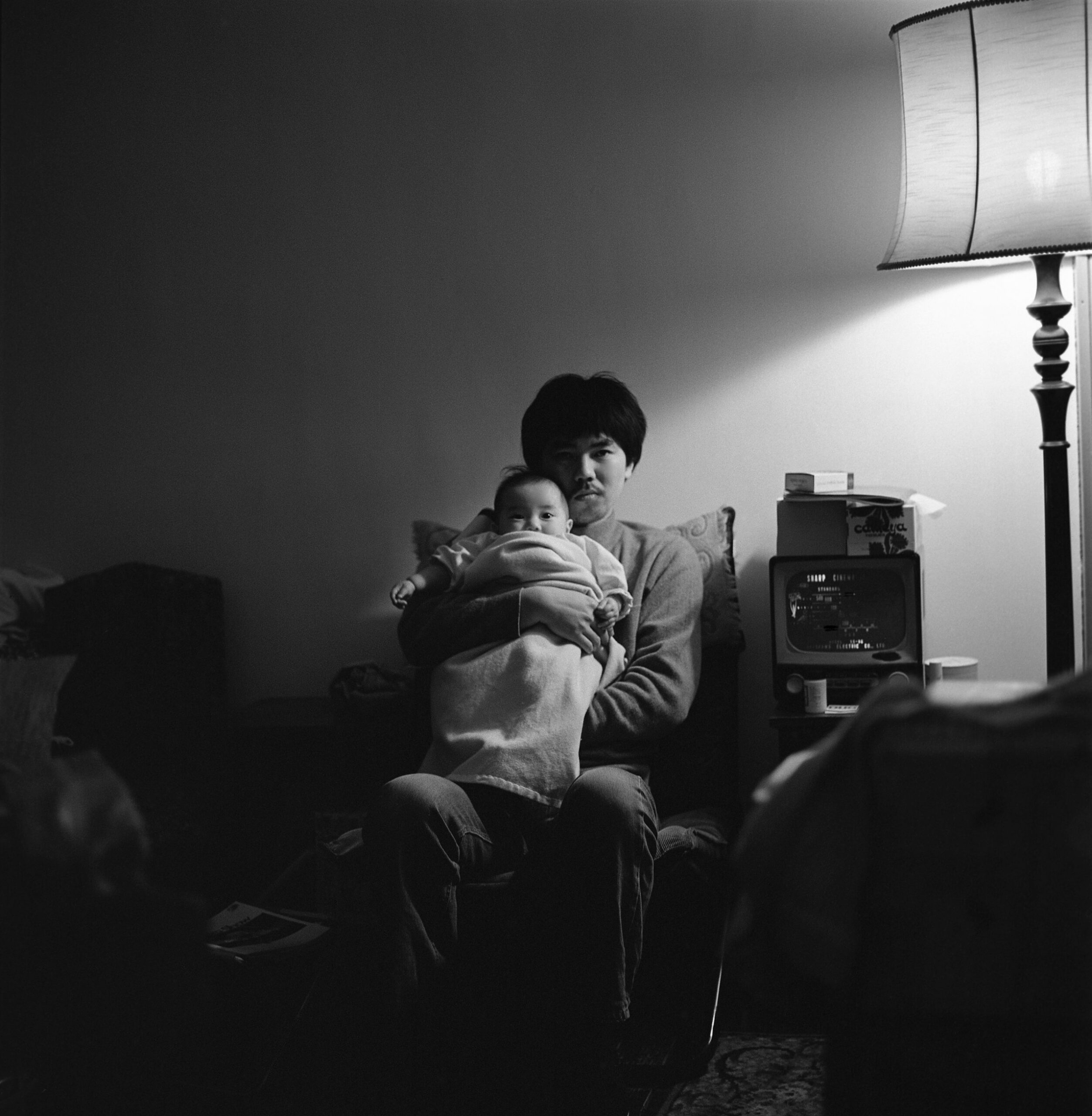
In My Husband, the other series presented in the exhibition, the subject is instead a person: her husband, observed across the long duration of a relationship. Here, black and white plays a fundamental role. The removal of colour distances the image from immediate reportage and leads it towards a more contemplative register. The body of the other becomes both presence and memory. To photograph, then, means not only to observe another person, but also to question oneself and the time spent together, exploring the intimacy and distance that emerge within relationships over an extended period.
It is precisely this relationship with duration that forms one of the deepest points of connection with Rinko Kawauchi, born in 1972. More than thirty years separate the two photographers nevertheless share a common attentiveness to ordinary life. Their photography begins with what unfolds before their eyes, with a willingness to remain receptive to the world.
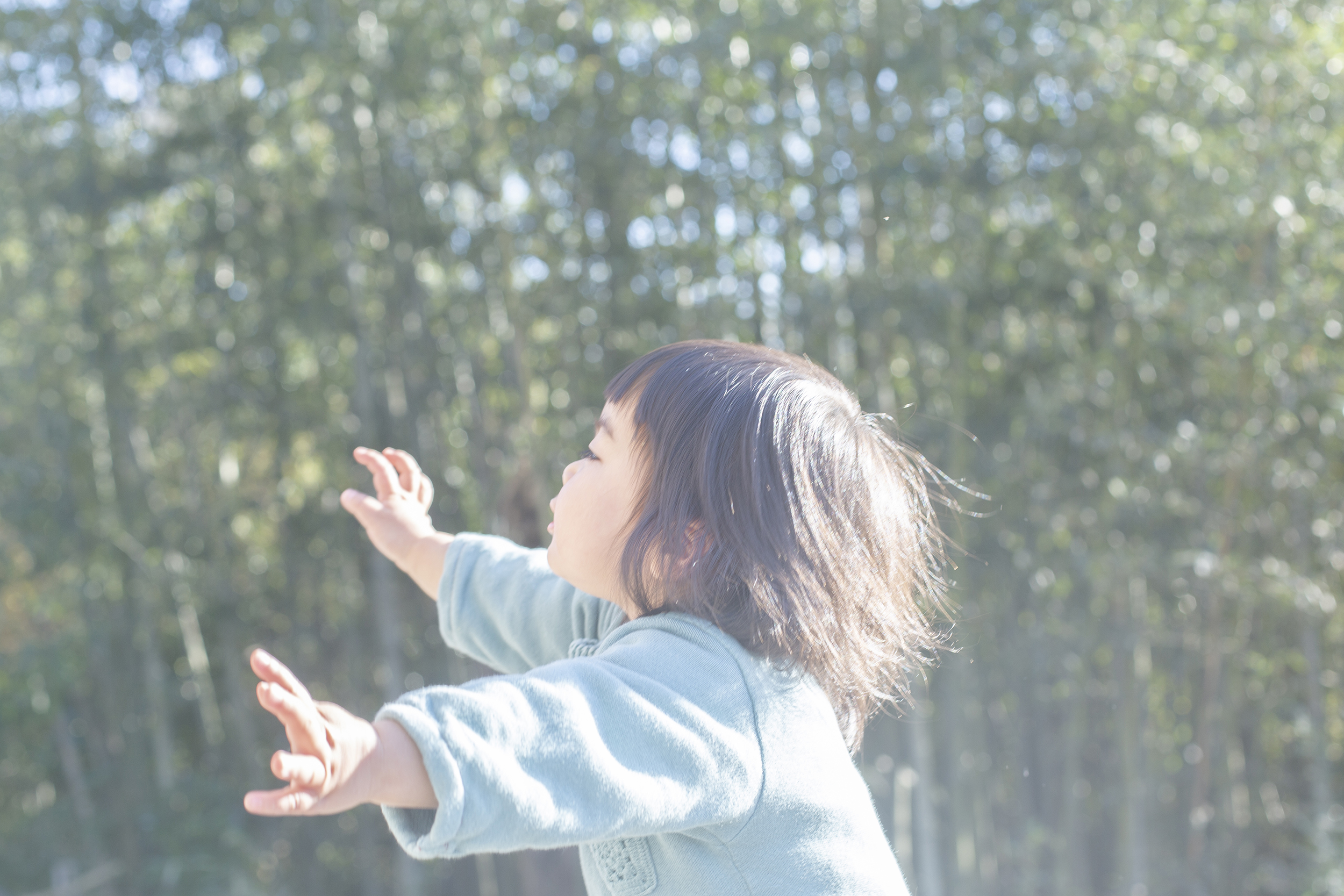
Kawauchi’s visual language, however, is radically different. If Ushioda observes, gathers and preserves, Kawauchi seems to pursue what is about to disappear. Her subjects are often minimal: a bubble, a flower caught in the light, translucent water, a running child, an animal, a fleeting gesture. Apparently insignificant fragments that, through photography, acquire an almost cosmic dimension.
Colour is the structural principle of her vision. Her images are suffused with delicate, luminous pastel tones, at times almost translucent. Reality remains concrete and earthbound, yet appears to lose its weight. The lightness of these pastel hues transforms the everyday into something suspended between presence and disappearance, a visual field in which the human figure occasionally emerges, quietly occupying the space.
In as it is and Cui Cui, the two series by Kawauchi presented in Arles, family and growth becomes part of a broader meditation on the cycle of life. Her gaze is intimate, but never possessive: she photographs what strikes her in its precariousness, “something fragile” that she feels compelled to hold on to. As Kawauchi observes, photography cannot stop life, but it can arrest a moment and allow us to return to it.
This is where the heart of From Our Windows emerges: two women photographing the lives unfolding before them, yet looking through different windows.
The Arles Exhibition creates a dialogue without attempting to erase the differences between them. The works of the two artists are arranged in spaces of equal dimensions, placed side by side, creating a visual equilibrium between two distinct photographic practices. This is not a fusion, but a conversation between two perspectives that share the same attentiveness to what is at risk of being lost.
At the centre of the Vague Arles space, some of Kawauchi’s photographs are printed on semi-transparent fabric and suspended beneath the stone vault. The images appear to float, becoming membranes between the visible and the invisible. It is an exhibition strategy that physically translates the nature of her work: images that do not simply ask to be looked at, but entered.
Kawauchi constructs her sequences through intuition. She chooses a first image and allows it to call forth the next, like solving a puzzle or assembling a patchwork. Ushioda, by contrast, works through duration, repetition and patient accumulation. One creates connections through association; the other through accumulation.
And yet both photographs for a profoundly similar reason: to preserve what risks disappearing.
The true subject of From Our Windows is therefore neither family, nor home, nor nature, nor objects. It is the time of relationships — the time that settles into things and bodies, transforming a husband into a shared memory, a refrigerator into a family portrait, a child into an adult, a flower into an image of transience.
In this sense, the exhibition is an exhibition about proximity. Two photographers look at what is closest to them in order to understand what is universal. The generational distance between Kawauchi and Ushioda is not erased; instead, it becomes the very device through which the project operates. A woman born in 1940 and another born in 1972 share the same present and, through photography, bring into dialogue the different eras they have lived through.
This is their “ecology of relationships”: a system in which people, objects, homes, nature and memory are inseparable. Ushioda preserves the traces of time through the black and white of materiality and experience; Kawauchi registers its dissolution through light and colour. One gathers what time leaves behind; the other tries to hold on to what time carries away.
Yet both photographs the same thing: life as it unfolds.
ABOUT THE AUTHOR
Silvia Ionna is an independent Art Director. She writes about photography, art, and books for various online magazines.

FRAMES is a unique international photography community that combines the best of all worlds, bringing you print and digital publications, a global membership platform, access to live events, and a dedicated mobile application.
EXPAND YOUR PHOTOGRAPHIC VISION
JOIN FRAMES TODAY