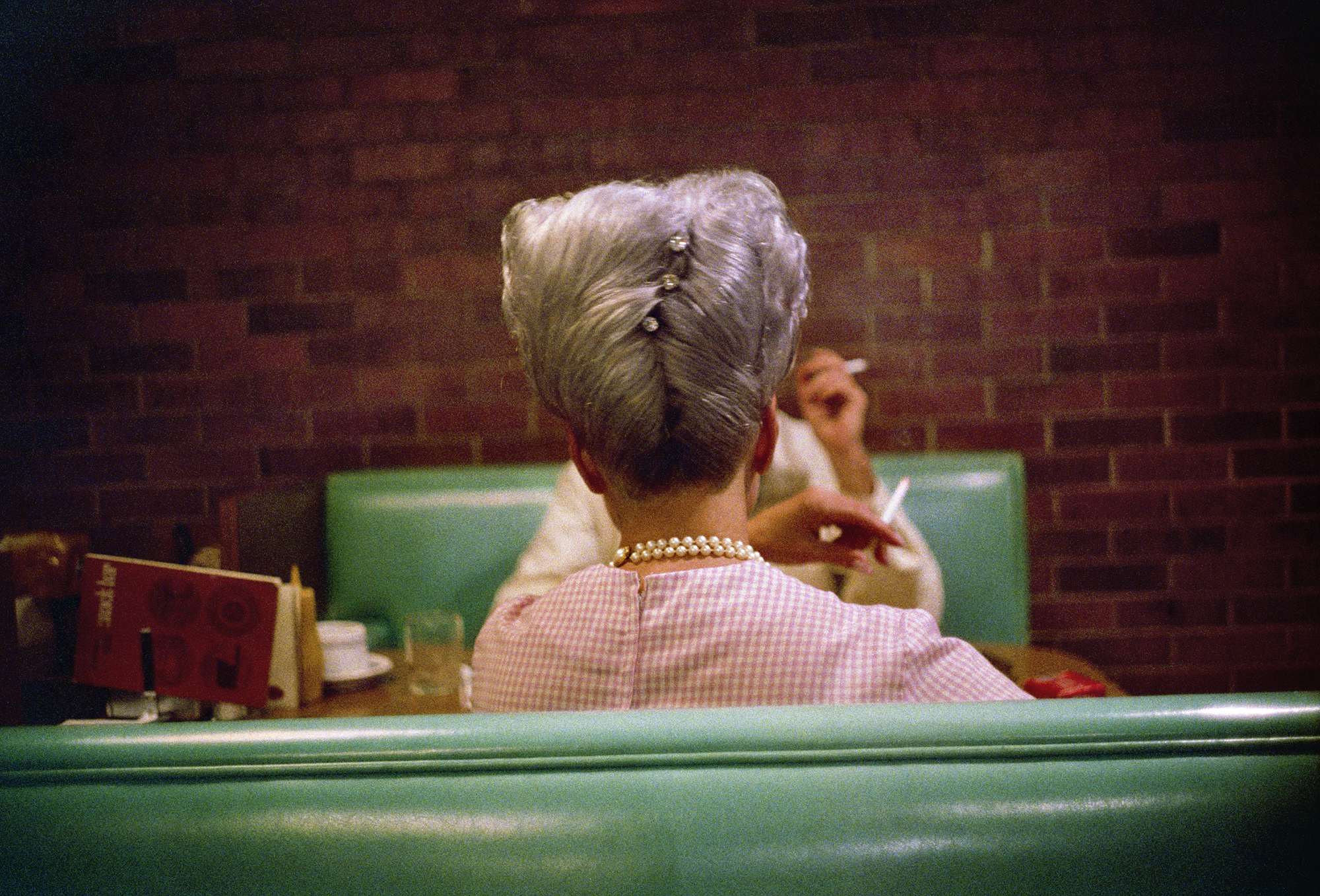
“I am at war with the obvious” are the words of William Eggleston, who famously expressed this sentiment during a conversation with author Mark Holborn. This quote leaves us wondering about Eggleston’s words. What exactly is “the obvious” in his photographs? In essence, Eggleston’s artistic world is one where the mundanity of everyday life is full of photographic potential. The obvious, surface-level aspects are always present. American diners, muscle cars, and road signs are playfully captured in an attempt to unveil — or, to put it more simply, to document — everyday Americana. Today, we look back on Eggleston’s remarkable body of work full of intrigue. The newest exhibition at The Photographers’ Gallery in London, William Eggleston: All That Goes Unnoticed, gives us much reason to think about his photographs.
The show marks the 50th anniversary of Eggleston’s landmark book, William Eggleston’s Guide (1976), and the supporting MoMA exhibition curated by John Szarkowski. While we have come to associate Eggleston with his vibrant color photographs, there was much media frenzy at the time the exhibition opened at MoMA. The dye-transfer process, which Eggleston revolutionized in his photography, had only ever been used for commercial photography before. The method, while arduous and time-consuming, utilizes a chemical reaction to layer magenta, cyan, and yellow on the final print. Through this method, Eggleston achieved a greater depth of colors and richly saturated tones. Yet, the critical reception of the MoMA exhibition stemmed from the widely held assumption that color photography was inferior to the established black-and-white aesthetic of the time.
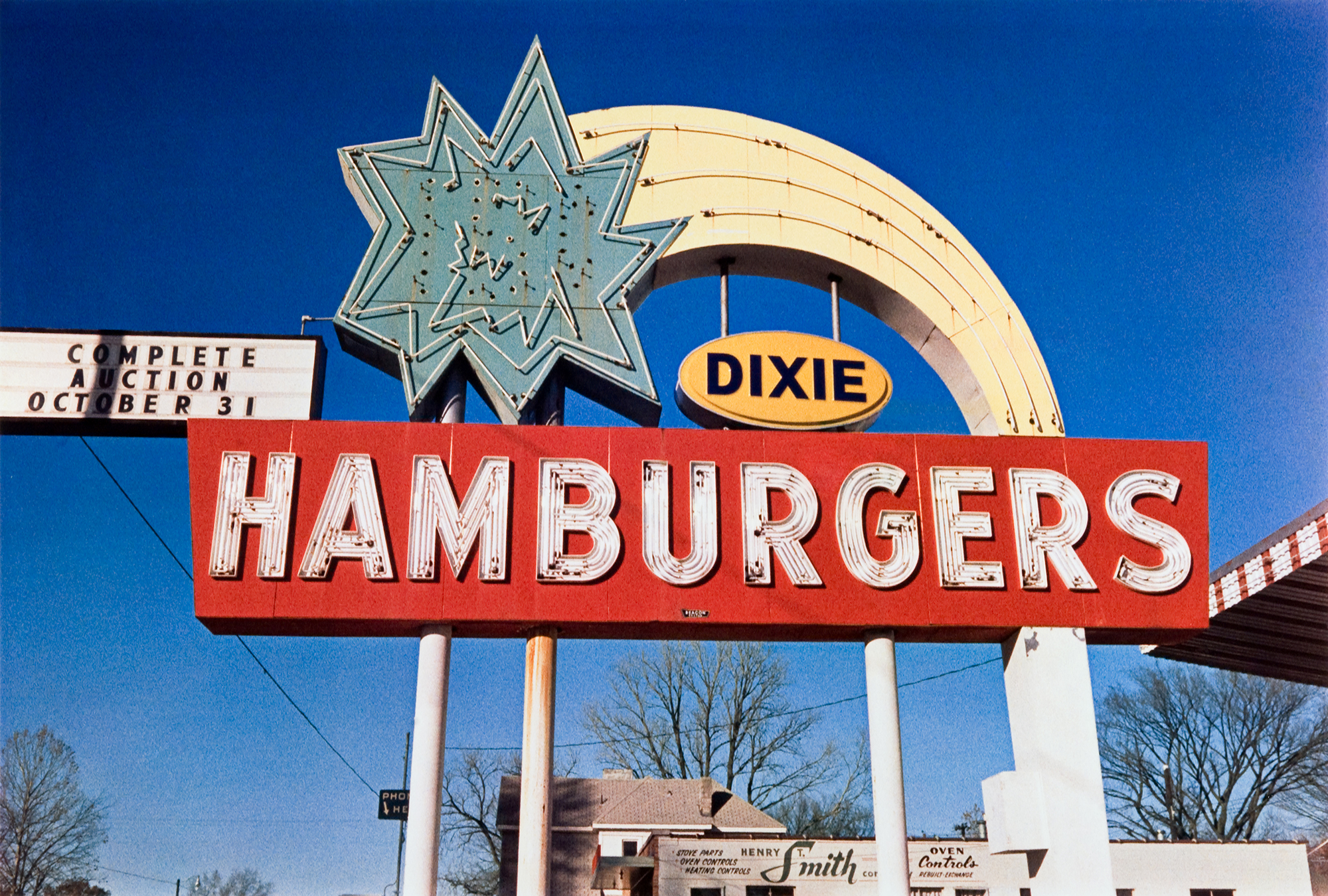
From the Wilson Centre for Photography
© Eggleston Artistic Trust, courtesy of the Eggleston Artistic Trust and David Zwirner
A point often overlooked by critics was that Eggleston’s photographs were distinctly his own and would later help redefine color photography. Before his foray into the dye-transfer method, Eggleston had in fact worked in black-and-white. A selection of lesser-known black-and-white images taken around Memphis, Tennessee, is displayed in rows of two, just as one enters the gallery. Here, we get a glimpse into the origin story of his photography: a monochromatic assemblage of suburban settings, impromptu portraits, and wide angles of American city life. Much about his early work conjures the photographs of Henri Cartier-Bresson, whom he cited as a direct influence. Like Cartier-Bresson, Eggleston carefully juxtaposes moments of solitude with the dynamism of urban life. The show also exhibits eighteen small-scale color images taken with a Brownie-format camera around 1969. Take, for example, a photograph of a shiny red Cadillac, a subject that would recur regularly in his work.
Eggleston’s propensity to capture the ordinary allows for an open-ended interpretation. The exhibition effectively presents the photographs at an expanded size. In many ways, they function as blank canvases. He leaves us much room for speculation by deliberately stripping away titles and captions from his works. Each photograph is titled “Untitled.” This lack of explicit linguistic context sets the stage for an interpretation devoid of predetermined narratives. It allows us to tackle his subjects in the most democratic way possible, by way of looking at composition, colors, framing, and most importantly, our own ways of seeing.
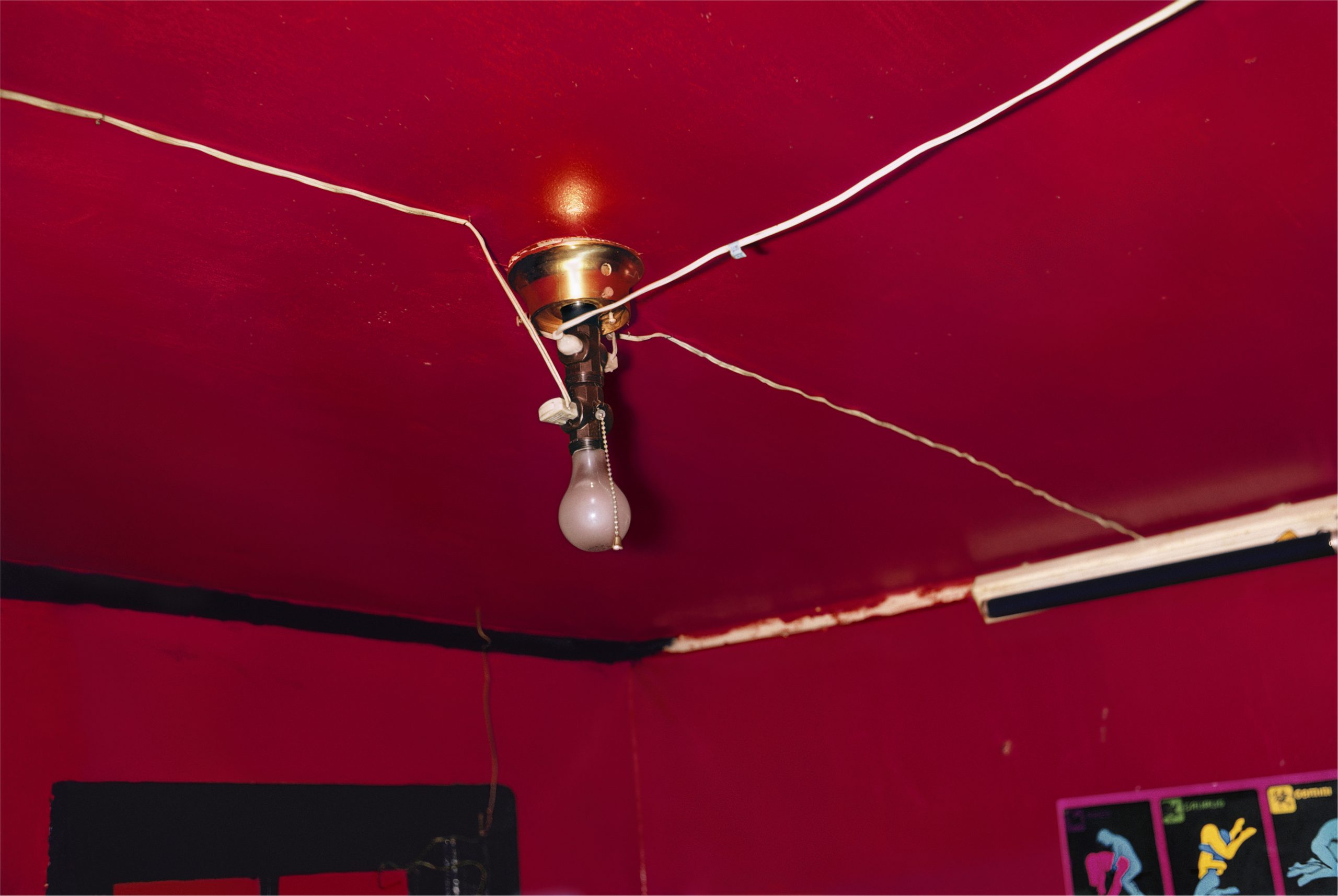
Finding the extraordinary in the ordinary is the central tension of the show and is best exemplified in the way Eggleston pushes colors past the point of realism, especially in his use of the color red. Among the exhibited photographs, we encounter an image of a red ceiling with a light fixture taken in Greenwood, Mississippi (1973). This photograph bends the laws of reading an artwork. The lurid red color, overtaking the entire frame, is the central focus and seeps gradually into the gallery space. We are drawn to a liminal space that this color conjures. Red is situated somewhere between life and death, carrying with it uncontrolled passion and desire. In fact, Eggleston considered red the most difficult color to work with and later compared it to a “Bach exercise.” At the time he was working on this photograph, he observed that red was primarily used in advertising. By unabashedly co-opting the commercial origins of the color, Eggleston masterfully creates a photograph in which the color itself becomes the center of attention.
From the Wilson Centre for Photography
© Eggleston Artistic Trust. Courtesy Eggleston Artistic Trust and David Zwirner
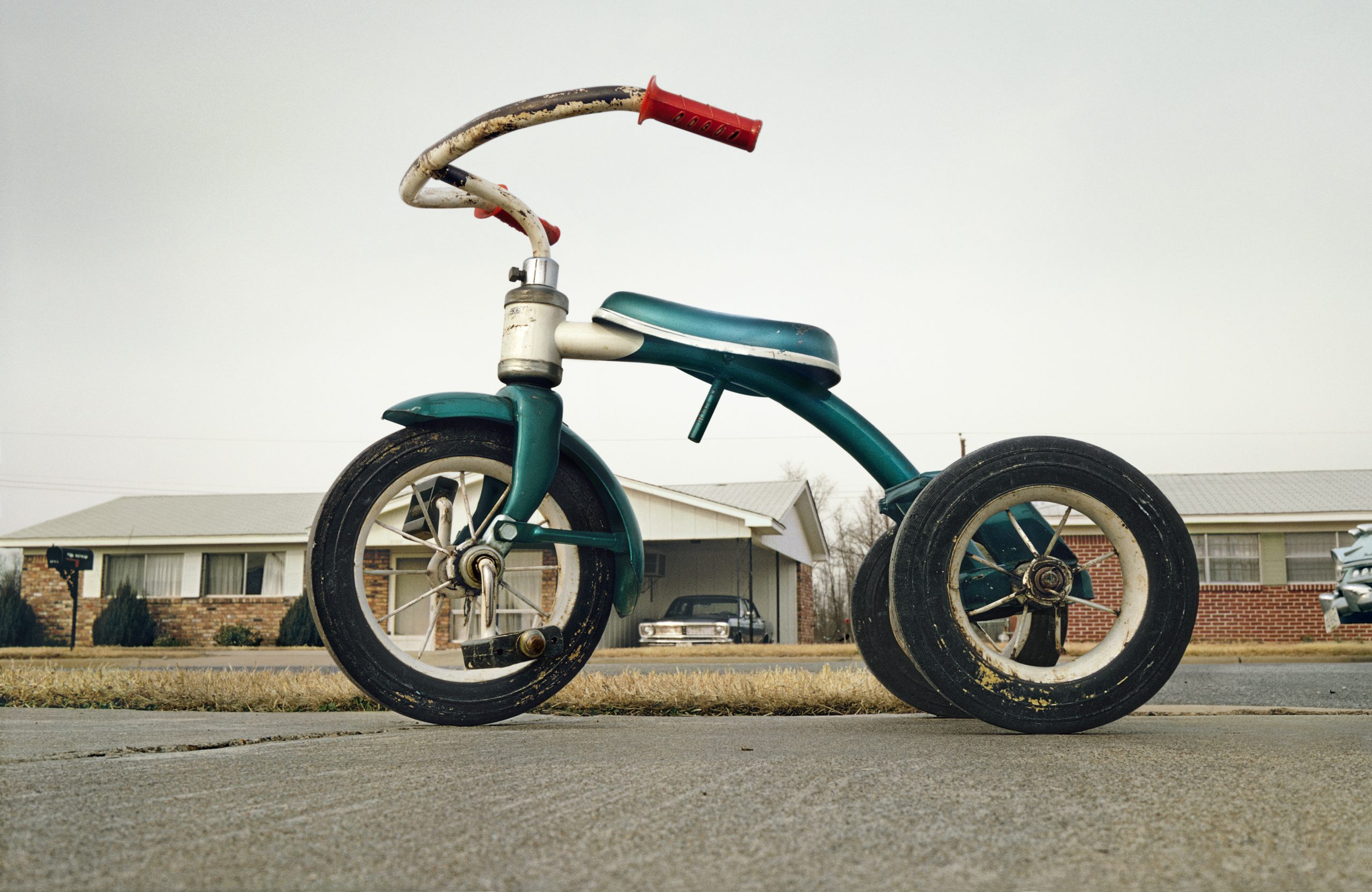
Clearly, what Eggleston excels at is the hyper-saturation of photographs through the dye-transfer process. This method serves as the foundation of his work. The process allows him to both intensify and elevate his subjects. Without a doubt, some form of myth-making is at play here. Allusive, yet very much his own: Eggleston’s subjects appear as though they stepped out of the world of Technicolor motion pictures from the early 1950s. Much like the films of Douglas Sirk, the tangible exists side by side with the intangible. Eggleston transforms the American South into an arena of psychological tension, akin to how Douglas Sirk used colors, lighting, and costumes to critique the artificiality of American suburbia in the 1950s. Both Eggleston and Sirk are masters in redefining our perception of the American way of life. In Eggleston’s photographs, there exists a thin veneer — an edifice built on the viewer’s assumptions — that feels as though it is constantly on the verge of cracking to reveal the futility of our attempts to interpret his work.
From the Wilson Centre for Photography
© Eggleston Artistic Trust. Courtesy Eggleston Artistic Trust and David Zwirner
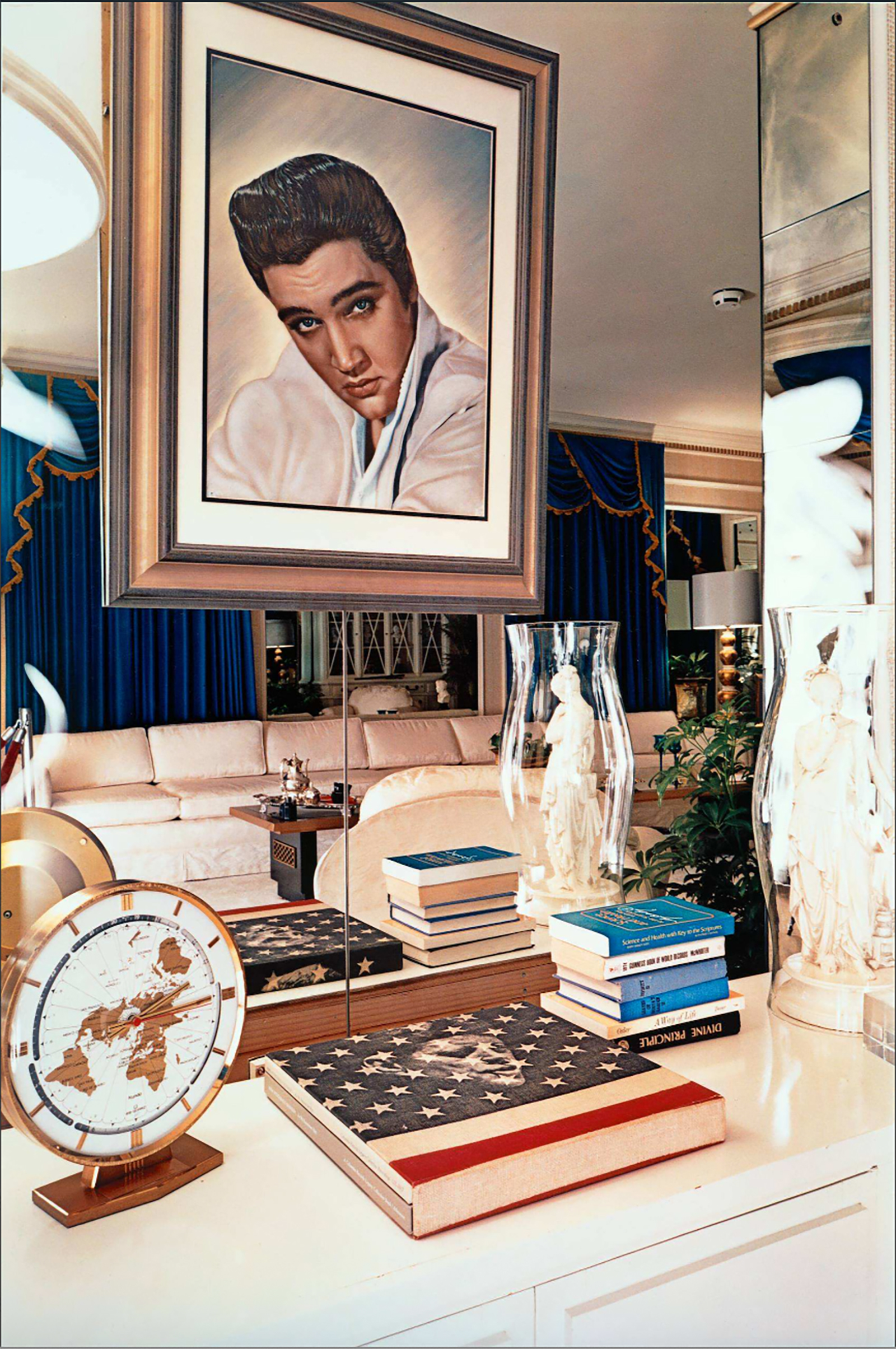
A great number of photographs in the show are tantalizing because of their ties to American popular culture. There is, for instance, the display showcasing the photographs Eggleston took of Graceland in 1983, a project initiated by the Elvis Presley estate for a guidebook featuring eleven dye-transfer prints. Within this series, we come across photographs of Elvis’ home, a brightly lit space with gaudy French décor. But more notably, we are confronted with a photograph featuring a large-scale portrait of Elvis hanging above a living room console table, on top of which sits a book featuring John F. Kennedy’s face on its cover. The photograph is characterized by a solitude that brings to mind an abandoned home. Elvis’ portrait in conjunction with JFK’s face creates a dialogue that is founded on the collective American imagination: the pop-cultural vis-à-vis the political. Both Elvis and JFK act as mirrors reflecting a mirage of the American dream, one that is both built on power and the allure of celebrity.
From the Wilson Centre for Photography
© Eggleston Artistic Trust, courtesy of the Eggleston Artistic Trust and David Zwirner
It is hard to pin down a common curatorial thread running through the exhibition because the subjects Eggleston depicts are recurrent in his later body of work. The display is fragmentary, slightly disjointed: Eggleston’s commission for the Coca-Cola Company (1996) exists alongside his Cadillac photo series (1999). The curatorial decision to arrange the works fluidly lends the exhibition a distinctive quality. In the spirit of Eggleston’s democratic camera, we are invited to view the works without hierarchy. No subject is granted precedence over another. Instead, the lasting resonance of the works speaks for itself. Eggleston makes us look at the world with a dash of curiosity that turns the mundane around us into the sphere of the unknown.
EXHIBITION
William Eggleston: All That Goes Unnoticed
Wed 14 Oct 2026 – Sun 21 Feb 2027
The Photographers’ Gallery
ABOUT THE AUTHOR
Can Heilmaier is a writer and editor based in the UK, with a background in the creative industries. He writes about photography, film, and visual culture.

FRAMES is a unique international photography community that combines the best of all worlds, bringing you print and digital publications, a global membership platform, access to live events, and a dedicated mobile application.
EXPAND YOUR PHOTOGRAPHIC VISION
JOIN FRAMES TODAY