First impressions count.
Yes, it’s a cliché, but it’s also true.
Every book designer knows you can’t judge a book by its cover, and yet everyone does exactly that. Not only is there content on the cover that hints at what’s inside, but there is also tone, mood, and style. And books are sensory artifacts as well. We hold them in our hands, feel the texture of the paper and cover. We see them with our eyes: the size of the font and the weight of the paper. We even have a special place in our hearts for the way a book smells.
Matthew Rolston – “Vanitas”
Published by Nazraeli Press in 2025
Review by W. Scott Olsen
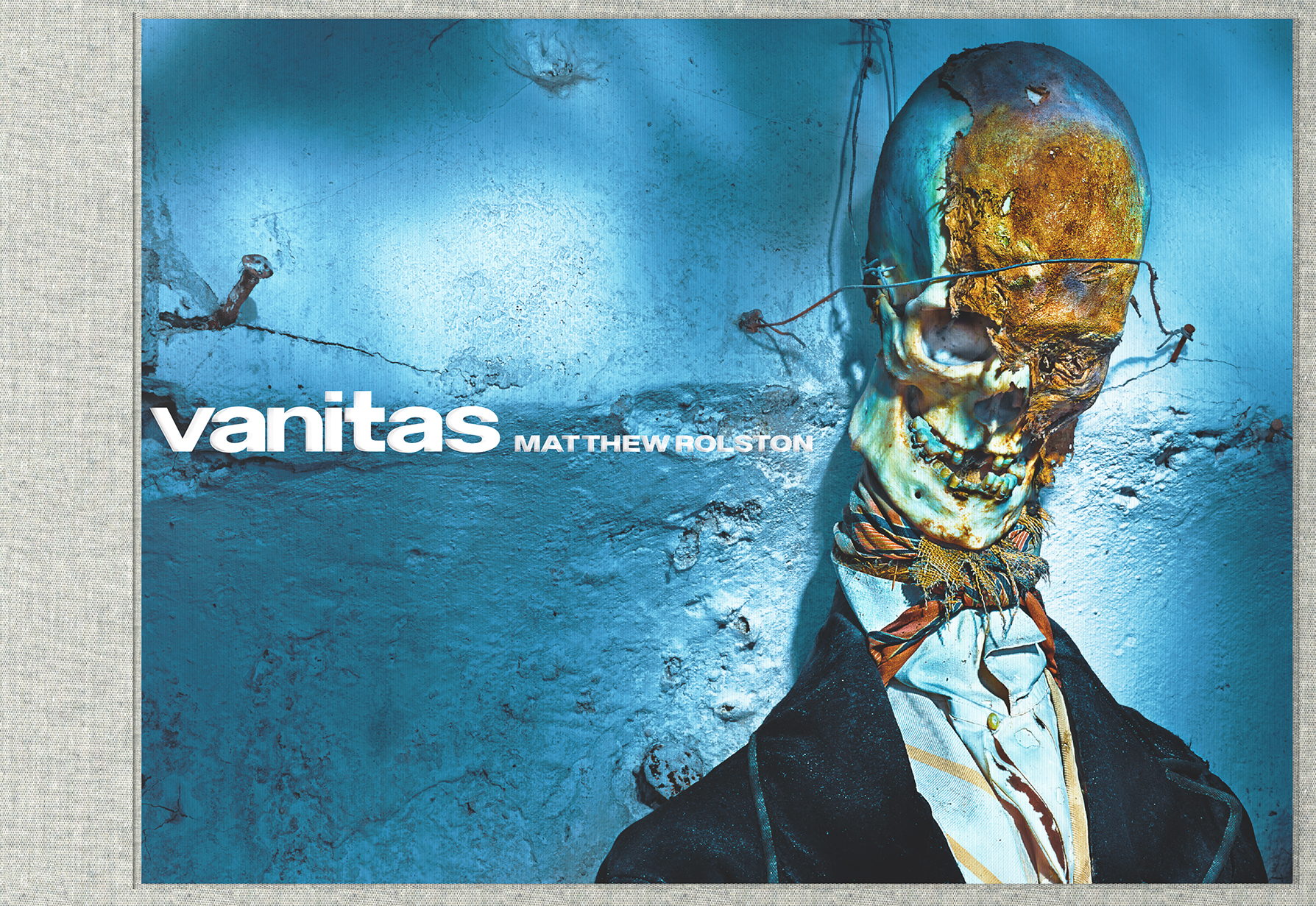
I bring this up now, at the beginning of this review, because just in terms of book-arts, Vanitas by Matthew Rolston and Nazraeli Press is a master-class of elegance and intent. Unwrap the cellophane, and you discover you are not holding a book—at least not yet. You are holding a hinged box, expensive with heavy covers and sides. Opening this box is one of those experiences where you can feel and hear the air in your room rush into the void.
Vanitas does not come in a small book box. Eighteen inches wide. Thirteen inches tall. An inch and a half deep. Holding it is not difficult, but it’s also not mindless. You are aware of the physical presence of the thing in front of you and the way you handle it.
And, of course, right there on the cover of the box, gargantuan and bright, is a portrait of a mummified dead man. Not stylized and romanticized like the remains of a Pharaoh. This guy is more recent. Much more recent. The portrait is not ghoulish—no Hollywood horror flick schtick here—but it is ghastly. The detail is sharp and unnerving. The slight tilt of his head looks back at us as if to say, “Yes, how can I help?”
What I mean to say with all this book-art stuff is that a first encounter with Vanitas is an act of opening, and unfolding, and coming into physical conversation with a subject we usually don’t wish to discuss: the physicality of death and our remains.
Vanitas, the book itself now, is equally well-produced. There are 50 four-color images, one per page on the right-hand side. Heavy paper. Bright plates. Its large size makes it a bit uncomfortable and awkward to handle, which is exactly the point.
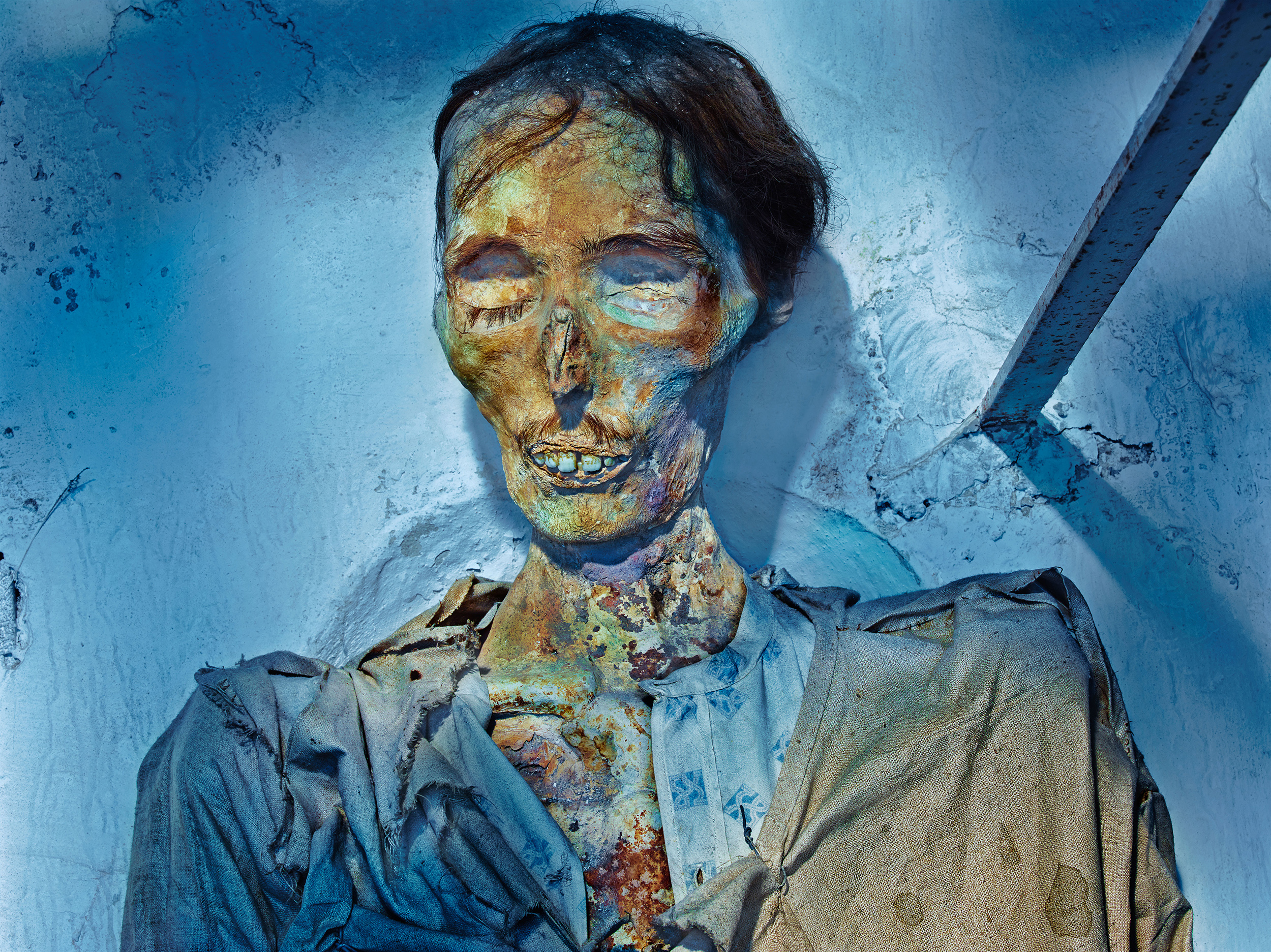
From the series “Vanitas: The Palermo Portraits” / Courtesy Fahey/Klein Gallery, Los Angeles
But why make a book of portraits, nearly all of them head-shots, of recent mummies?
In an introductory essay called “Eros and Thanatos,” Philip Gefter writes—
In 2013, Matthew Rolston, a photographer known to have redefined Hollywood glamour with the roster of celebrity portraits he had made over the years, spent a week at the Capuchin Catacombs in Palermo, Sicily staring into the faces of seventy mummies…
Driven by a realization that his career and high-style Hollywood portraiture had foregrounded youth and beauty in its inherent denial and negation of death, Rolston proceeded with the impulse of the artist to make portraits of each mummy, their hollowed out faces and contorted remains providing a focus of contemplation about the meaning and purpose of our time here on earth, the transitory beingness of life and the phenomenon of consciousness, and the inescapable destination for us all—the implacable nothingness of death…
Rolston finally found what he was looking for in the Capuchin Catacombs of Palermo, at the Church of Santa Maria della Pace, which dates back to the 16th century. Initially only the “frati Cappuccini”—the church friars—were interred there in sackcloth. According to legend, the first of the frati who were placed in the crypt did not decompose. This was considered a divine miracle, as if the place had been touched by God, giving rise to the belief that the catacomb was a direct portal to the afterlife… The mummies Rolston photographed are standing, held by the wires with which they were initially strung to the walls and columns as it was thought that their upright position would put them first in line to enter heaven’s gate.
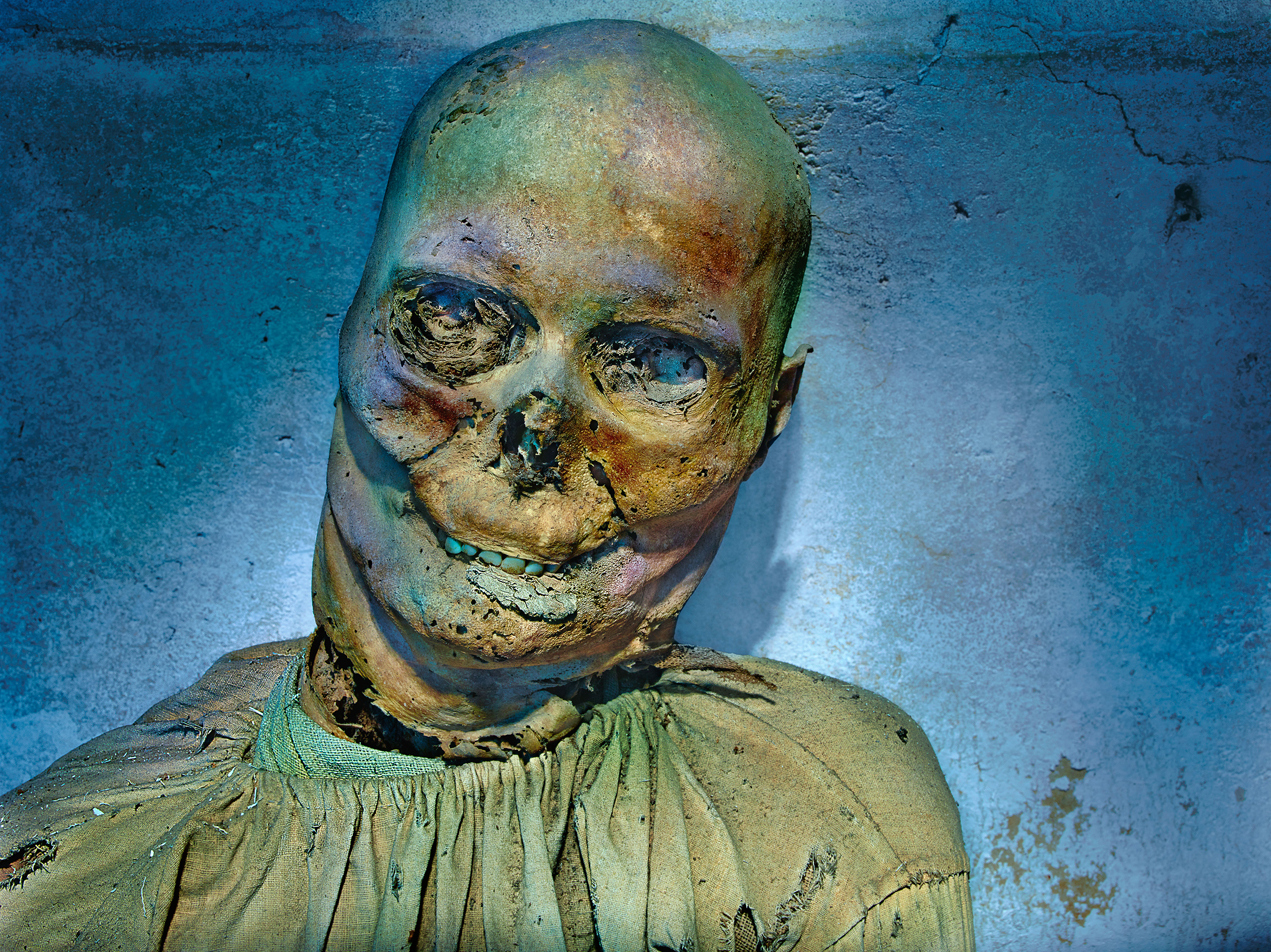
Matthew Rolston, “Triptych in the Style of an Altarpiece, center panel, Untitled (Smiling I)“, Palermo, 2013
From the series Vanitas: “The Palermo Portraits” / Courtesy Fahey/Klein Gallery, Los Angeles
In a journal entry positioned as its own type of introduction, Rolston himself writes—
the reason i am here is to explore a place where the living confront the dead. it is a very direct experience, there’s really no ‘buffer’—no glass partitions, no ‘climate control’—no little cards on the wall to explain it all to the viewer. Instead, what you see is what you get. dead people. up close and very personal. there IS a sign as you enter. it says “what you are now, we used to be. what we are now, you will become.”
these dead seem to be full of emotion—suffering—anguish—pain—maybe even laughter. but i know that the impression of emotion is a ‘projection’ of the living. the twisted bodies, gaping mouths, the staring empty eye sockets are all a result of the body’s decomposition. nevertheless i find these figures deeply affecting. they move me. the first time i came here i had to stifle a sob.
To be clear, Vanitas is not a photojournalist’s documentary project, although it has that element in it. Vanitas is fine art portraiture, informed by theology as well as art history. For example, in a brief concluding essay, Rolston writes, “In the Vanitas series, the choice of dominant blue tones signifies that hue’s devotional relevance to traditional Catholic dogma and display. As such, the color carries with it a quality that conjures both the melancholy and the transcendent.”
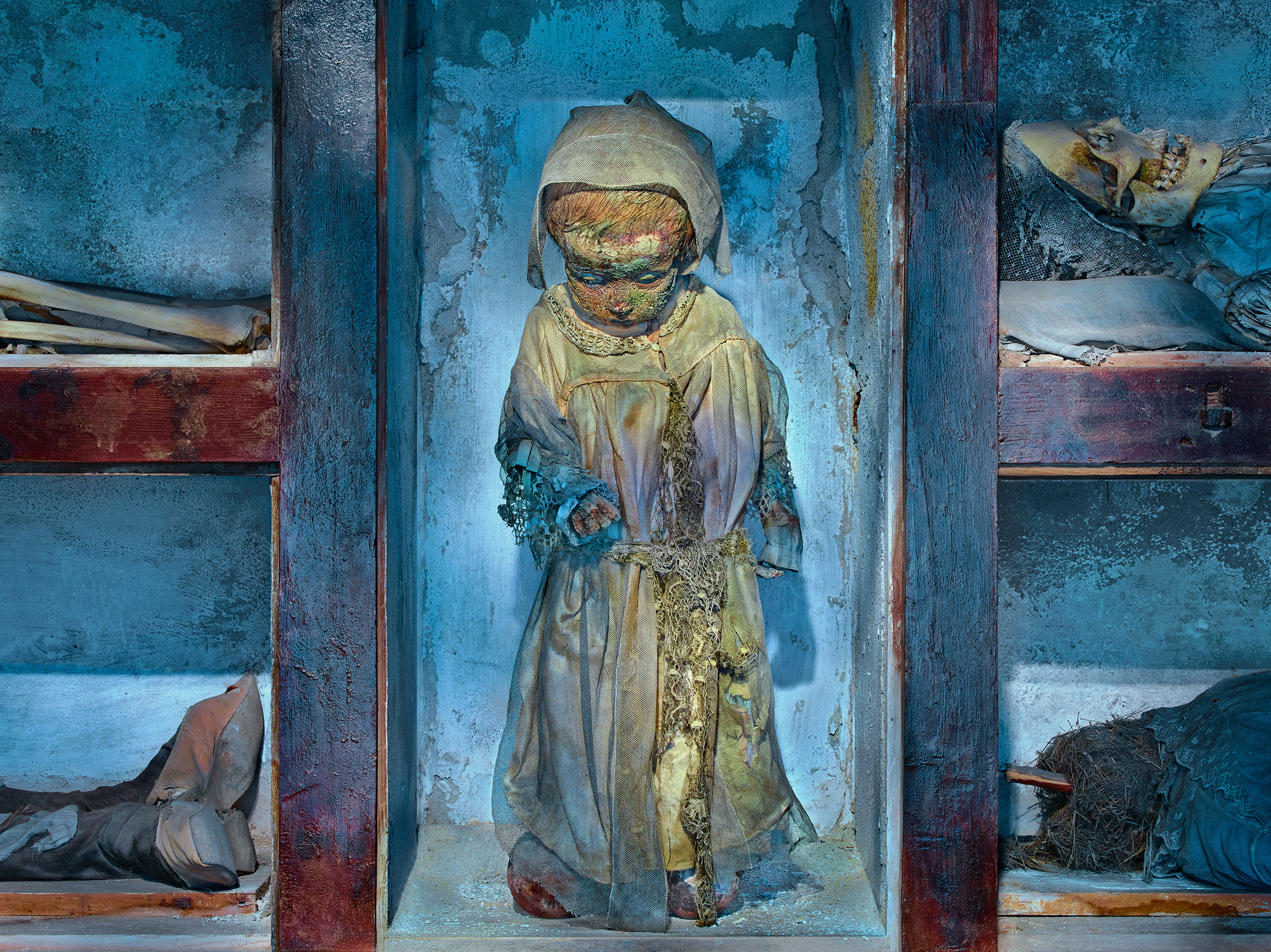
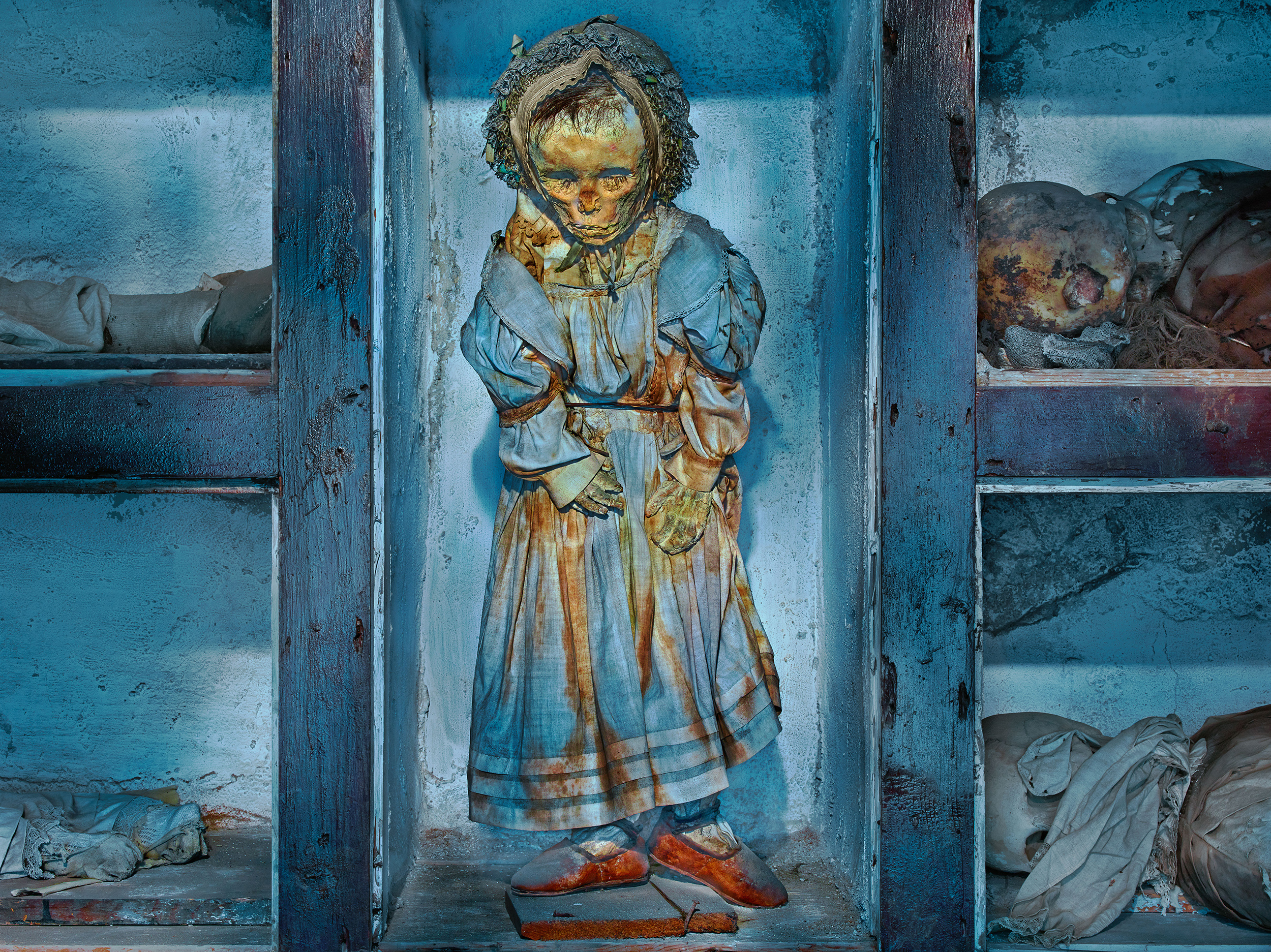
Matthew Rolston, “Triptych in the Style of an Altarpiece, right panel, Untitled (Child II)”, Palermo, 2013
From the series “Vanitas: The Palermo Portraits” / Courtesy Fahey/Klein Gallery, Los Angeles
Rolston acknowledges and celebrates his participation in a long line of artists who have entangled themselves with the subject and even this site, such as Otto Dix, Richard Avedon, Lucian Freud, El Greco, Francis Bacon, and others. He writes, “Today, left to neglect, reduced to shreds of their former glory, these mummies remain both twisted and eternally poised, as mannered as Schiele’s watercolors of tortured flesh.”
Going through this book, it is impossible not to be simultaneously aghast and intrigued. Every desiccated face implies the visage that used to be there. Every bit of clothing implies the character’s character and style. Every portrait stares out at us and poses the question of whether or not we will become like this. There is a sadness to this book as well as a real sense of beauty. Rolston’s art is exquisite in capturing something idiosyncratic about these corpses. It goes well beyond mere spectacle, misguided faith or hope, to perhaps simply the insistence of mortality. The pages here refuse to be turned quickly. The details of real human lives, the intimate details of humans after death, seen through the emotions and skill of art, give this book an insistent power.
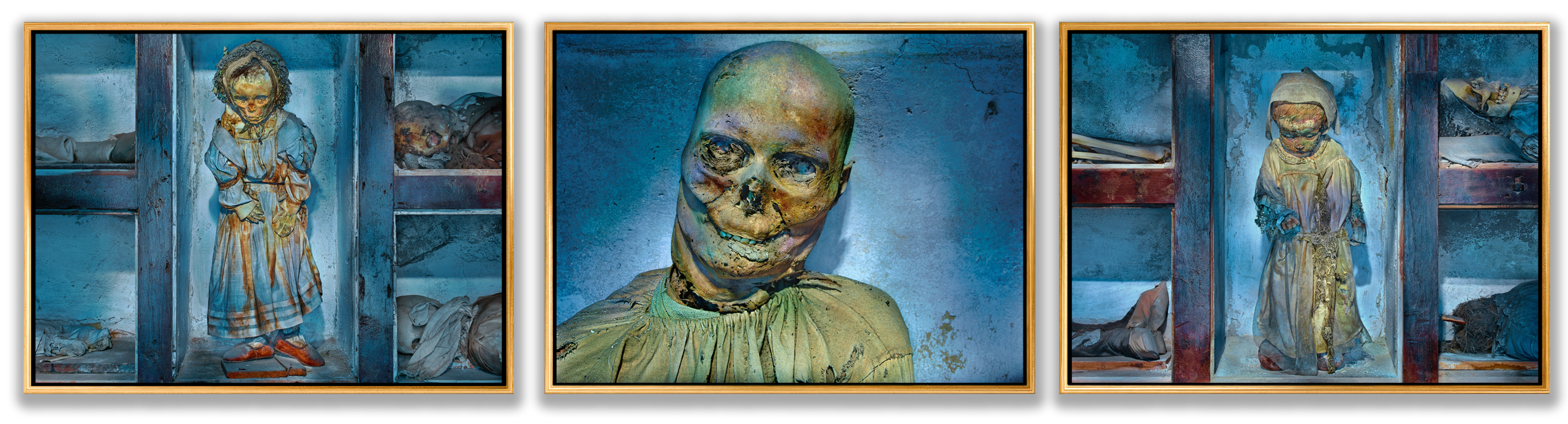
L-R: Untitled (Child I); Untitled (Smiling I); Untitled (Child II)
From the series “Vanitas: The Palermo Portraits” / Courtesy Fahey/Klein Gallery, Los Angeles
There are, of course, lots of other places to see human remains. But strolling through the catacombs of Paris, or the Sedlec Ossuary in Czechia, for example, what we see is only bones. The skeletons have become anonymous, which is to say they’ve become safe. It’s impossible to tell Yorick from anyone else. In Vanitas, these people still have their names. And from the moment you open the box and hear the air rush in to lift up the pages, that inhalation being the very first moment of encounter, I swear you can hear these corpses whisper.
To learn more about Matthew Rolston’s Vanitas project, please visit: https://www.vanitasproject.com.
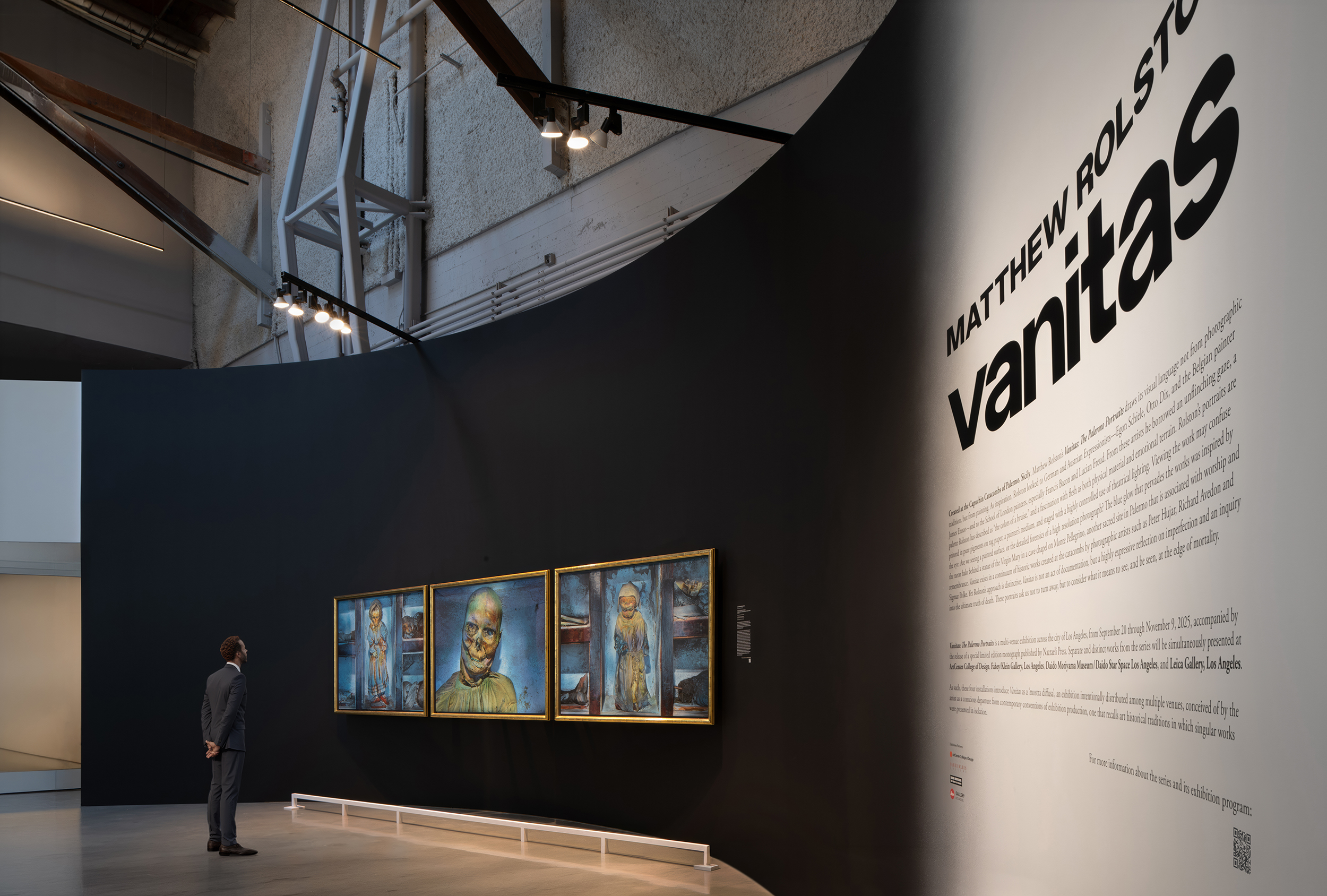
Installation view, ArtCenter College of Design, Mullin Transportation Design Center, Pasadena, California. Photographed by Kara Kirk, 2025
A note from FRAMES: Please let us know if you have an upcoming or recently published photography book.

FRAMES is a unique international photography community that combines the best of all worlds, bringing you print and digital publications, a global membership platform, access to live events, and a dedicated mobile application.
EXPAND YOUR PHOTOGRAPHIC VISION
JOIN FRAMES TODAY