
I have often wondered why we are so in love with geometry.
Shapes of any sort have always called to us. Circles, squares, cubes, trapezoids. It doesn’t really matter if we’re talking about the Monster Group of symmetry, complex fractals, or a child’s Spirograph. When we give something a form, what it gives back to us is a type of pleasure.
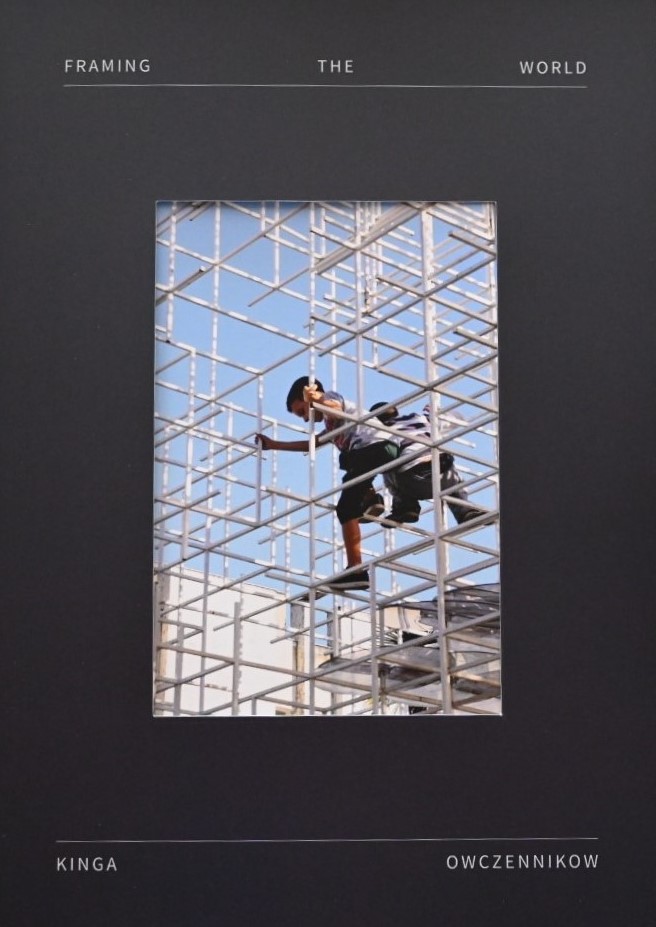
Kinga Owczennikow – “Framing The World”
Published by ephemere in 2025
Review by W. Scott Olsen
Some time ago, it dawned on me that the reason for this might not lie in aesthetics as much as in physics. The Second Law of Thermodynamics is that all things tend toward chaos. All things tend toward disarray. What this means is it takes less work to have something completely akilter than it does to give it order. The First Law of Thermodynamics is the Conservation of Energy, which states that energy cannot be created or destroyed in a closed system, but it can be transferred or transformed. So take the universe and give it time. Things fall apart.
Everything we know is in some state of dissolution, unless we inject work, unless we inject order. I think we know in our bones that all things tend toward disarray, both in real terms and metaphoric, so a shape that is an order is a step against the dissolution of the universe. Something as simple as a leading line, which is a story, a shape, an order, is a hope.
I’m thinking about geometry this morning because I have on my desk a wonderful book called Framing the World by Kinga Owczennikow. This is a collection of photographs about frames. Not artsy picture frames hanging in some gallery, but the way frames might occur in doorways, in windows and sidewalks and fences. The way frames might appear when our habits in the built world somehow give us a perspective on the natural world.

To put a frame around something is to give it a definition. To put a frame around something is to focus our focus, to consider both what’s inside the frame and what’s outside the frame. Keep in mind that every frame in this photo book is always doubled. There is the frame, which is the subject of the photograph, and then there is the frame of the image itself.
Looking at this book is magnificently complex and rewarding. Every first glance reveals an interesting and pleasing setting, a sophisticated understanding of composition and color. And there is that framing element. When you start to really think about what that’s doing there—oh my.

In a foreword by Tom LeClair, he writes—
All photographs frame the world. “Framing the World” presents photographs with internal frames that sharpen focus on the world and refine viewers’ understandings of their viewing—of both the world and photographs. In Kinga Owczennikow’s photographs, internal frames can attract and resist, reveal or deceive, imply their own limitations. Even imply viewers’ limitations, the cognitive frames through which they process the world. If at first glance the photographs here seem humble and simple, the internal frames invite second thoughts and questions…
With its various world locations in different kinds of frames, Framing the World is ultimately a celebration of photography, how its inventive framings change our perceptions of the world and, possibly, reframe our understanding of how we perceive—up to down, left to right, center to margin, light to dark.
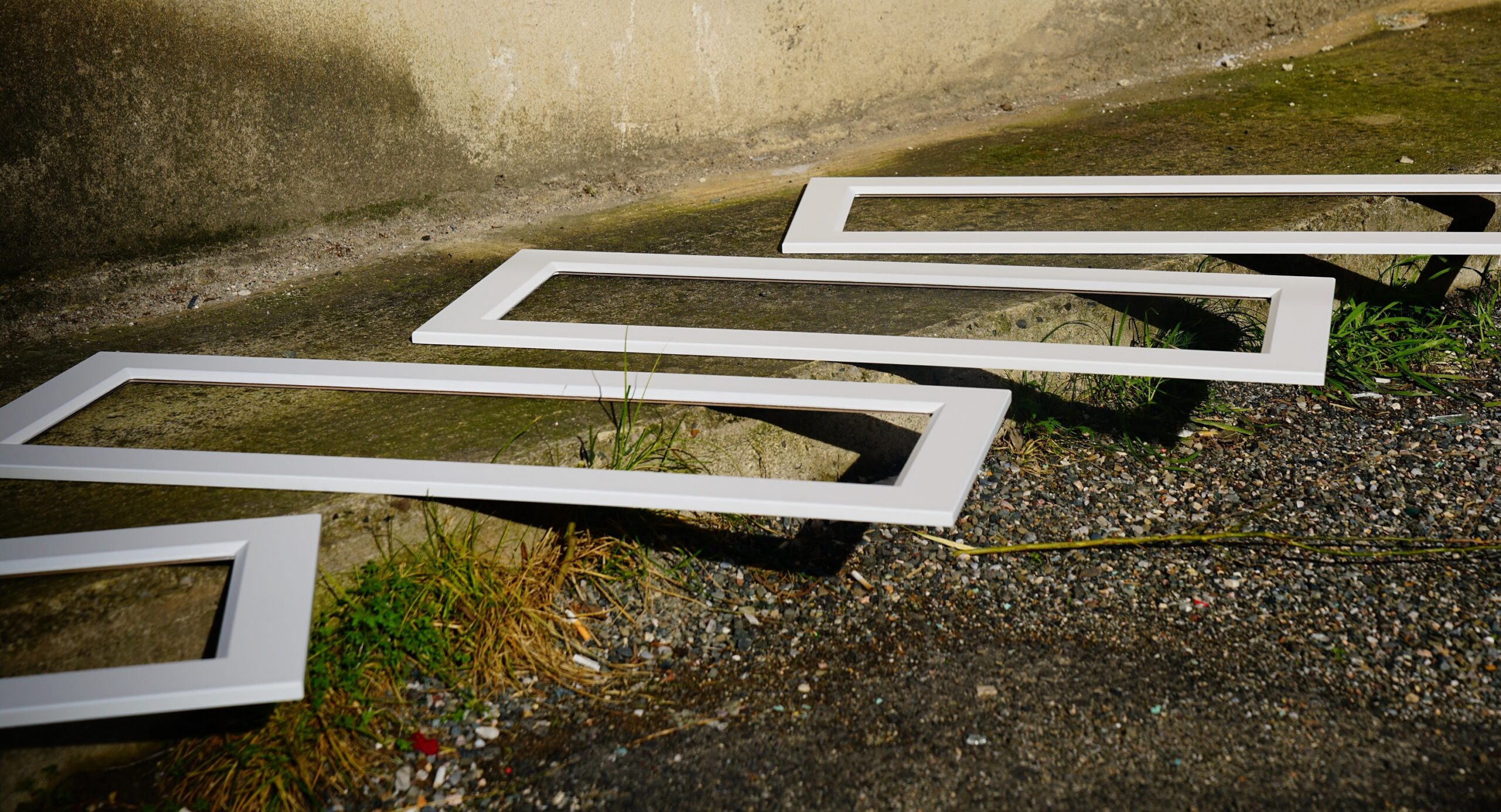
Framing the World is not a large book, and it is elegantly produced. Sixty-eight pages. Fifty-three photographs. Each image has a location and a year, not so much a caption as simple context, and that’s it. And each image has some type of internal frame. Going through the book is a playful exercise with how a simple bit of order, encompassing sometimes randomness and sometimes not, gives us a kind of focus that allows us to limit and then articulate what’s inside the frame. It could be a Mobius strip on a brick wall, or electrical wires surrounding an open window space, silhouettes on the Staten Island Ferry framed by the windows. Every image in this book gives us an inside and an outside, and the border itself.
Each image is deeply pleasing because of the way it asks not only for aesthetic appreciation, but philosophic contemplation, too. When you include, by definition you exclude. What is inside a definition always implies what’s out. And to have both things present at the same time is a step that both acknowledges the Second law of Thermodynamics and asserts a wonderful bit of hope that we can at least understand it. Perhaps in understanding, we can keep it at bay just a little while longer. Framing the World is one of those photo books that is beautiful and gets into your head as well as your heart.
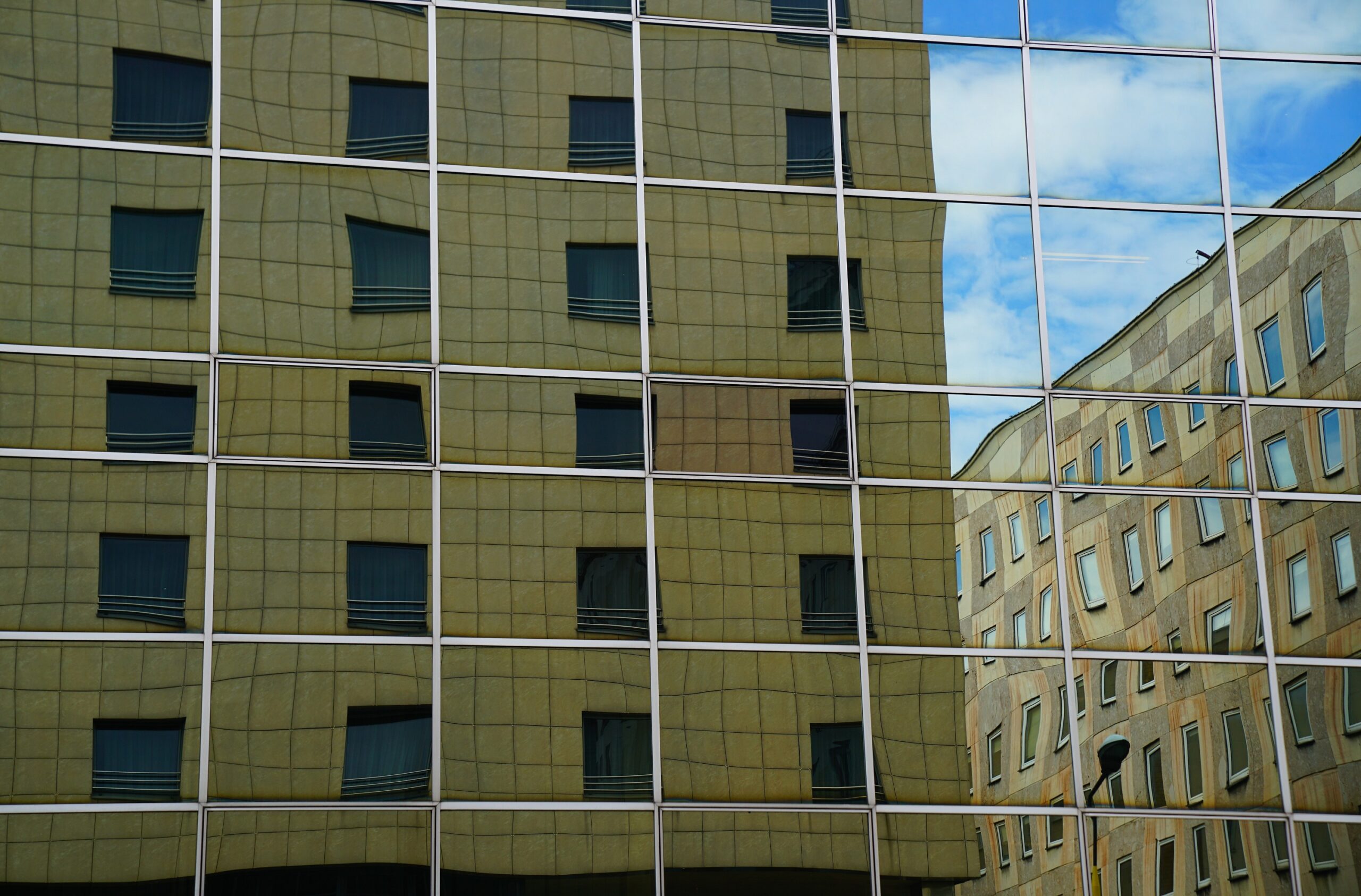
To be clear, none of the images in this book are about either the First or Second Law of Thermodynamics. They are, instead, about the borders we construct to understand, to celebrate, to focus our lives. The images in this collection include an ornate green fence in front of a beach scene in Margate, a kind of proscenium arch which appears to be set up for a wedding in the Maldives, the support to hold very large signage on the side of the building in Toronto, the square patterns of windows in Warsaw, and a doorway in Santorini. More often than not, the frame inside the image is in the foreground, but not always. A tree in Tirana grows in front of a blue frame, exploding its borders.
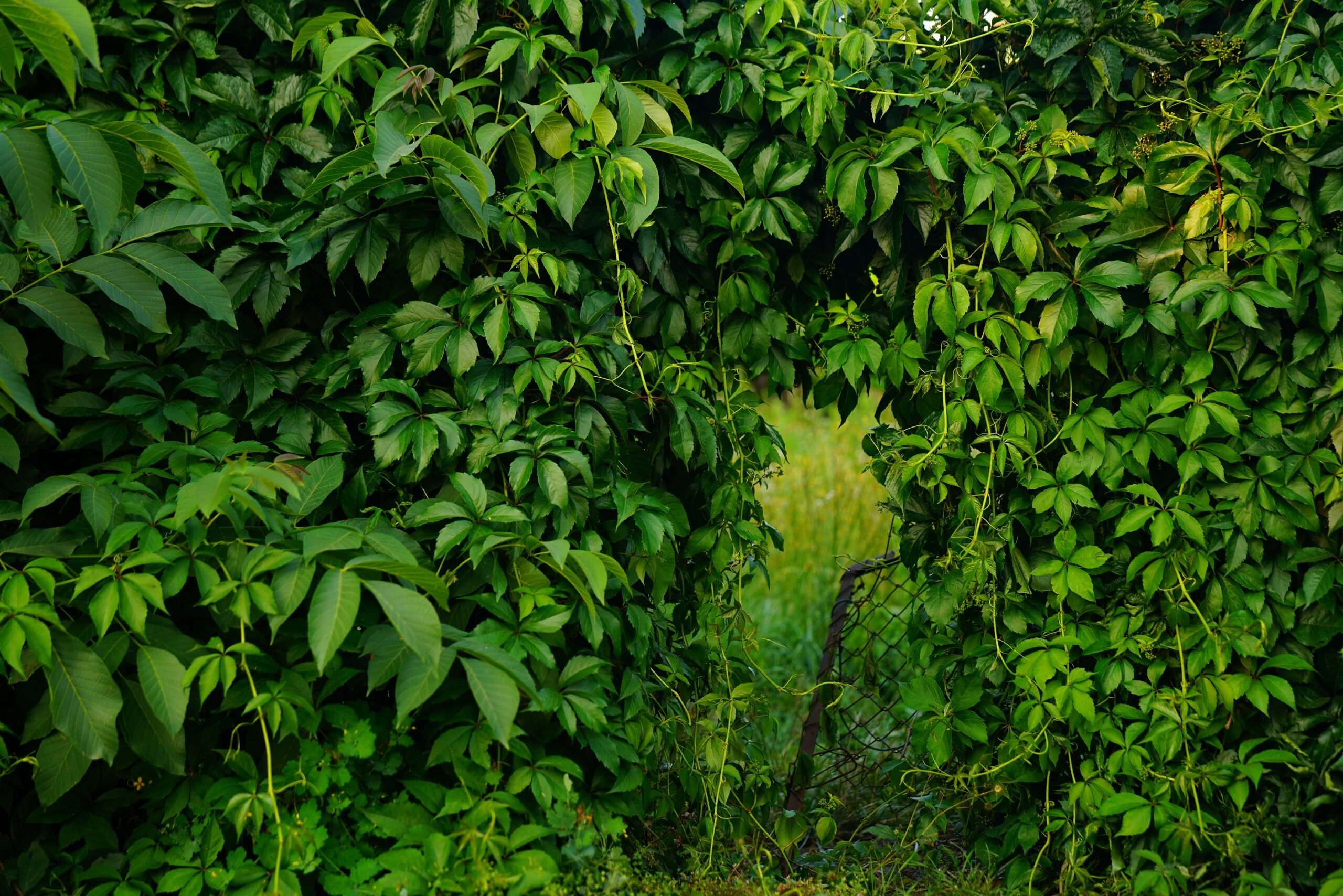
What these photographs ask us to consider is our desire to organize our lives and how we understand the environments we move through. The frame serves as a focusing device as much as the subject itself. There are questions of utility here, questions of definition. Because a frame is an act of separation (which is sometimes a very good thing) that allows us to see what’s inside more clearly, these images are a commentary on humanity. To take a step back and simply ask why framing gives us pleasure, that’s the step that leads to the nature of the universe.
A note from FRAMES: Please let us know if you have an upcoming or recently published photography book.

FRAMES is a unique international photography community that combines the best of all worlds, bringing you print and digital publications, a global membership platform, access to live events, and a dedicated mobile application.
EXPAND YOUR PHOTOGRAPHIC VISION
JOIN FRAMES TODAY