At the 2026 Les Rencontres d’Arles international photography festival, the exhibition Lueur nomade—dedicated to the American photographer Ming Smith and curated by Daisy Desrosiers—offers a pivotal retrospective of her artistic contribution across the decades.
Designed as a photographic, artistic, and geographical cartography, the Arles exhibition restores the full stature of a photographer whose vision was shaped not only as a cornerstone of American photography, but also through prolonged encounters with Europe, its architectural landmarks, museums, and visual traditions. Smith’s presence at Arles this year engages in a broader, essential dialogue with other Black artists featured throughout the festival, transforming the event into a powerful celebration of Blackness.
The festival thus becomes the ideal stage to reaffirm a complex narrative, driven by the ability of these artists—from Paul Kodjo to Sammy Baloji—to resist any attempt to define or categorize Black’s identity as immutable or easily readable, instead celebrating its interiority as fluid, luminous, and ever-evolving.
Ming Smith’s artistic trajectory unfolds by dismantling the rigid boundaries of the classical photographic medium. In her work, faces dissolve, contours become fluid, and spectral figures evoke the realm of memory rather than mere documentary record. This approach emerges forcefully in the integration of career-defining shots born from a deep interconnectedness with music and lived experience.
Consider the famous genesis of her close-up portrait of Tina Turner on the Brooklyn Bridge, taken in 1984 on the set of the music video What’s Love Got to Do with It. Smith was not there as an official photographer, but as a background dancer, hired through friends working on the production. Seizing a quiet moment during a break, she captured the singer’s reflective, vulnerable gaze, stripped of her stage persona. This defines Smith both stylistically and humanly: her capacity to be the right woman at the right time, practicing absolute resilience in combating intersectionality—an iconoclastic example herself as a Black woman from a working-class background.
Courtesy of the artist.
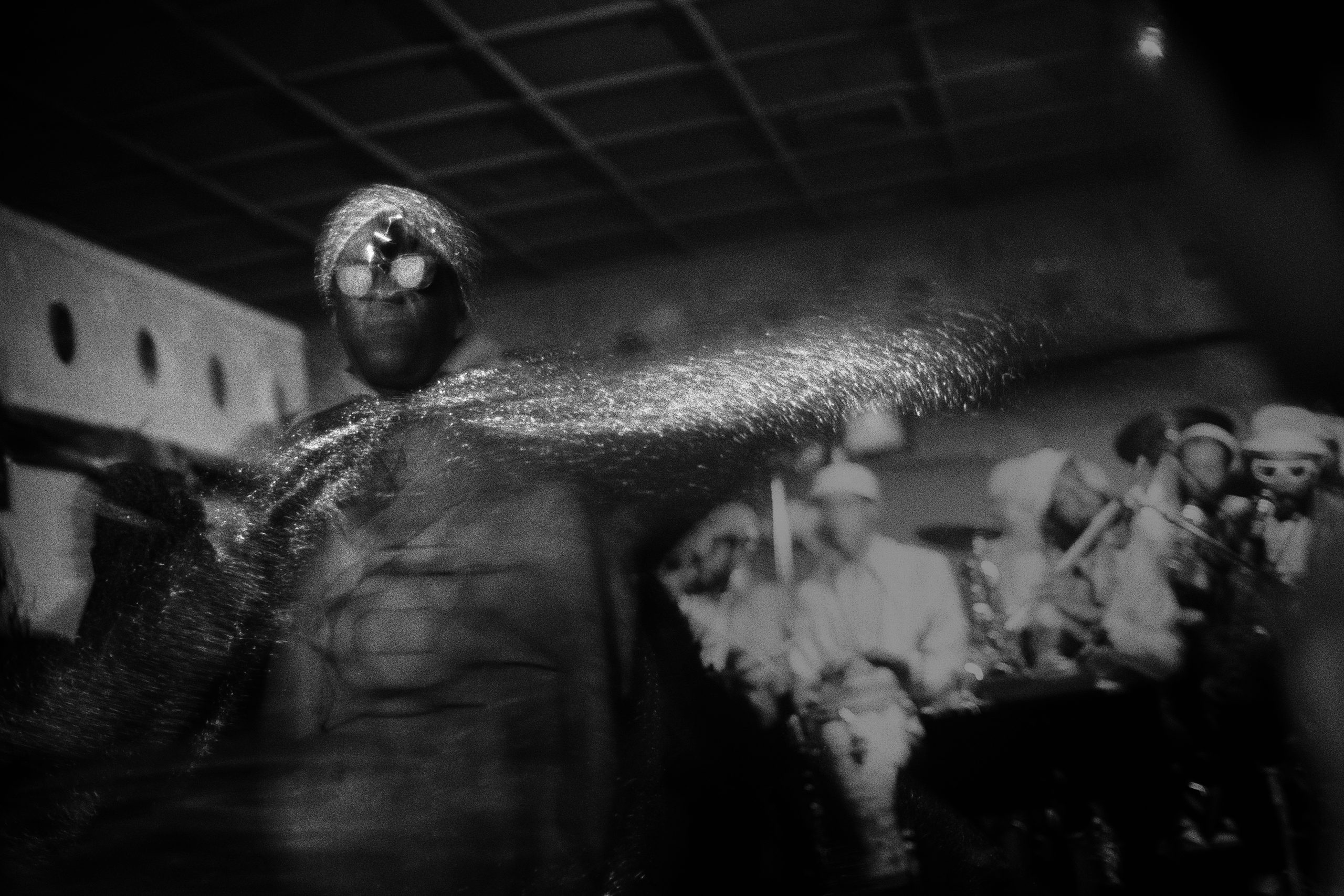
The year 1979 marked a watershed moment for Smith’s career when the Museum of Modern Art in New York acquired her photograph David Murray in the Wings. With this acquisition, she became the first Black woman photographer to enter MoMA’s permanent collection. Yet, upon arriving at the gallery, staff mistook her for a delivery person, unable to conceive that the author of that vision was an African American woman.
Defying marginalization and an initially derisory financial offer, Smith resisted with fierce determination. That historic purchase finally forced the visibility of Black American female culture into an art institution that had systematically ignored Black and female voices. This photograph epitomizes the core elements of Smith’s poetics: a high-contrast black-and-white image where the jazz saxophonist partially emerges from the shadows, embodying the indissoluble link between Smith’s photography and the sonic forms of blues and jazz.
She honed this technical mastery and sharp edge within a very specific environment: the avant-garde collective Kamoinge Workshop, which she joined in 1972 after being noticed by photographer Louis Draper while modeling at Anthony Barboza’s studio. Founded in New York in 1963 to promote the work of Black photographers ignored by the white establishment, the collective found its first and only woman in Ming Smith—a prophetic inclusion given her subsequent historic acquisition by MoMA. The weekly meetings were spaces of fierce critique; a transformative and grueling experience for a shy young woman with a background in microbiology, yet one that allowed her to develop her “radical intuition” and her poetics of motion blur.
Indeed, Smith’s intentional use of image movement, blur, and slow shutter speeds suggests a fascinating structural parallel with the contemporary work of the Japanese photographers of the Provoke movement. Both collectives, though operating in distant geographical and cultural contexts, shared a style that sabotaged the canons of sharp, descriptive photography in favor of an aesthetic of instability and movement.
Where Provoke used fragmentation to challenge the rigidity of reality, Ming Smith utilizes the flou and spectral figures as a mode of intentional attention. In the style of Smith and the Kamoinge Workshop, as in that of Provoke, the frame ceases to be a protective enclosure and transforms into a porous meeting place, where the instability of the image mirrors the fluidity of sensation and time.
Ultimately, Smith’s oeuvre functions as a visual rhythm where cultural, musical, and literary references become essential. Her 1976 photograph Invisible Man, Somewhere, Everywhere draws direct lines to Ralph Ellison’s seminal 1952 novel Invisible Man. In both, the image of a Black man—ignored by the world he inhabits, struggling to assert himself within a ruthless society that completely overlooks him—is captured by the photographer, creating a synesthesia that translates into a potent gesture of social and racial critique.
Similarly, her photographic analysis of non-places and the social abstraction of her subjects traces a formal and emotional parallel with the photography of Dave Heath. Both authors share a profound interest in the psychological dimension and the intricate vulnerability of their subjects, translating isolation and loneliness into highly speculative, lyrical compositions.
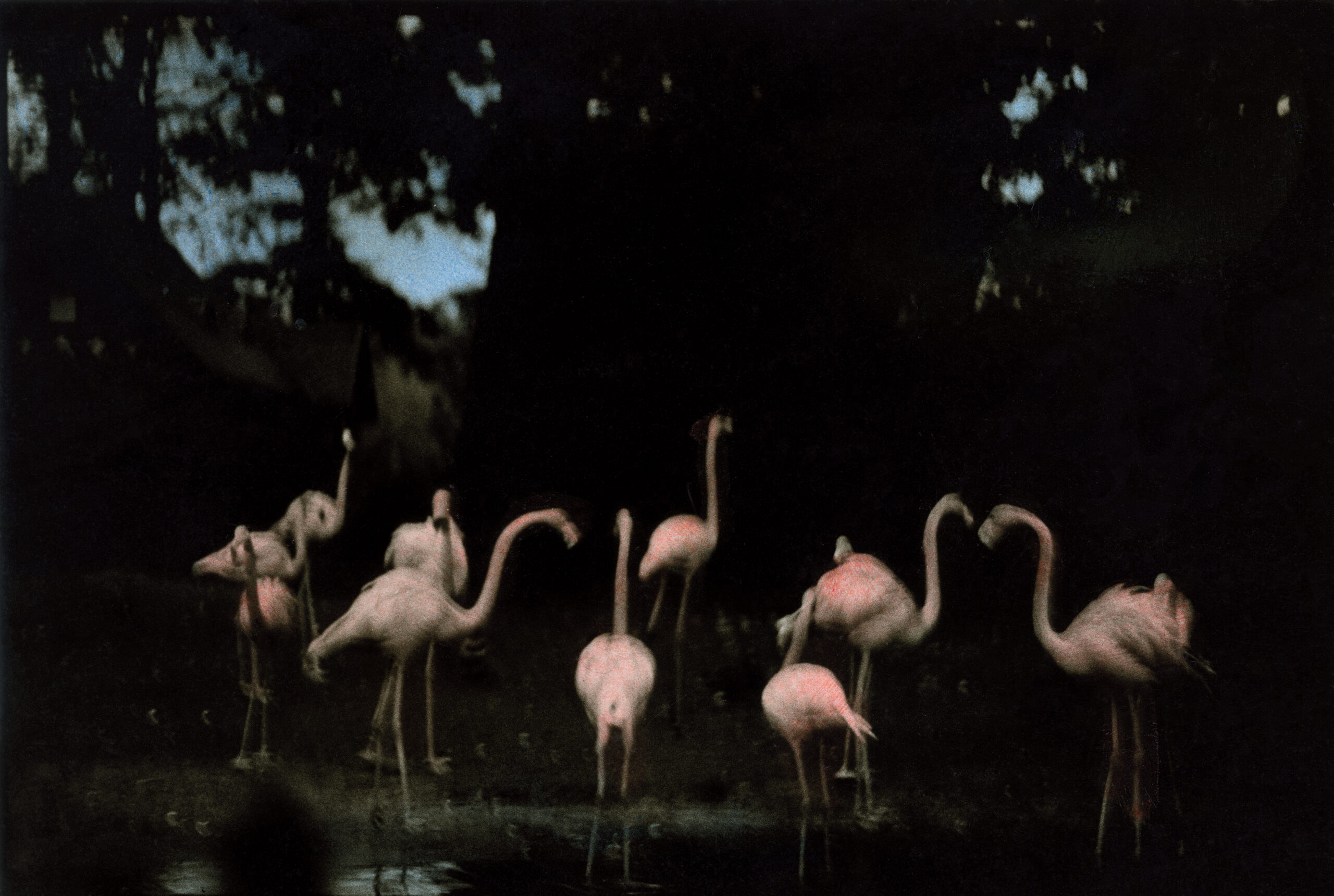
Yet, while Heath operates largely within a rigorous purism of the silver gelatin print, Smith approaches the photographic medium as a field open to the logic of painting. This is best demonstrated by her celebrated Painted Photographs, where hand-applied color on black and white—such as the swirling white strokes in Angel at Convent Avenue or the chromatic alterations in America Seen Through Stars and Stripes and My Father’s Tears—heightens the latent spiritual and emotional energy. It confirms that for Ming Smith, to photograph is, above all, to capture the way light and feeling strike the human spirit.
Ming Smith – Wandering Light
July 6, 2026 – October 4, 2026
Opening hours: 9:30 AM – 7:00 PM
Curation: Daisy Desrosiers
Exhibition produced by the Rencontres d’Arles.
With support from Sézane.
ABOUT THE AUTHOR
Silvia Ionna is an independent Art Director. She writes about photography, art, and books for various online magazines.

FRAMES is a unique international photography community that combines the best of all worlds, bringing you print and digital publications, a global membership platform, access to live events, and a dedicated mobile application.
EXPAND YOUR PHOTOGRAPHIC VISION
JOIN FRAMES TODAY